Between the diaper and the skin, the reusable diaper liner seems almost trivial. Yet, it can simplify stool removal, preserve the fabrics, and provide a dry effect, depending on its material. Disposable or washable, it is not essential: the right choice mainly depends on changing habits, the baby’s skin, and the time available for maintenance.
Article in brief
This small sheet can make changing easier and protect diapers without being mandatory. Material, thickness, and care make all the difference in everyday life.
- Its role: It facilitates stool removal and limits stubborn stains.
- Options: Disposable or washable, each solution meets different habits.
- Dry effect: Some draining liners keep moisture away from the skin.
- The right choice: The material and size adapt to the baby.
Remember: the liner is a practical accessory, to be chosen according to the family’s needs.
Reusable diaper liner: what is its real purpose?
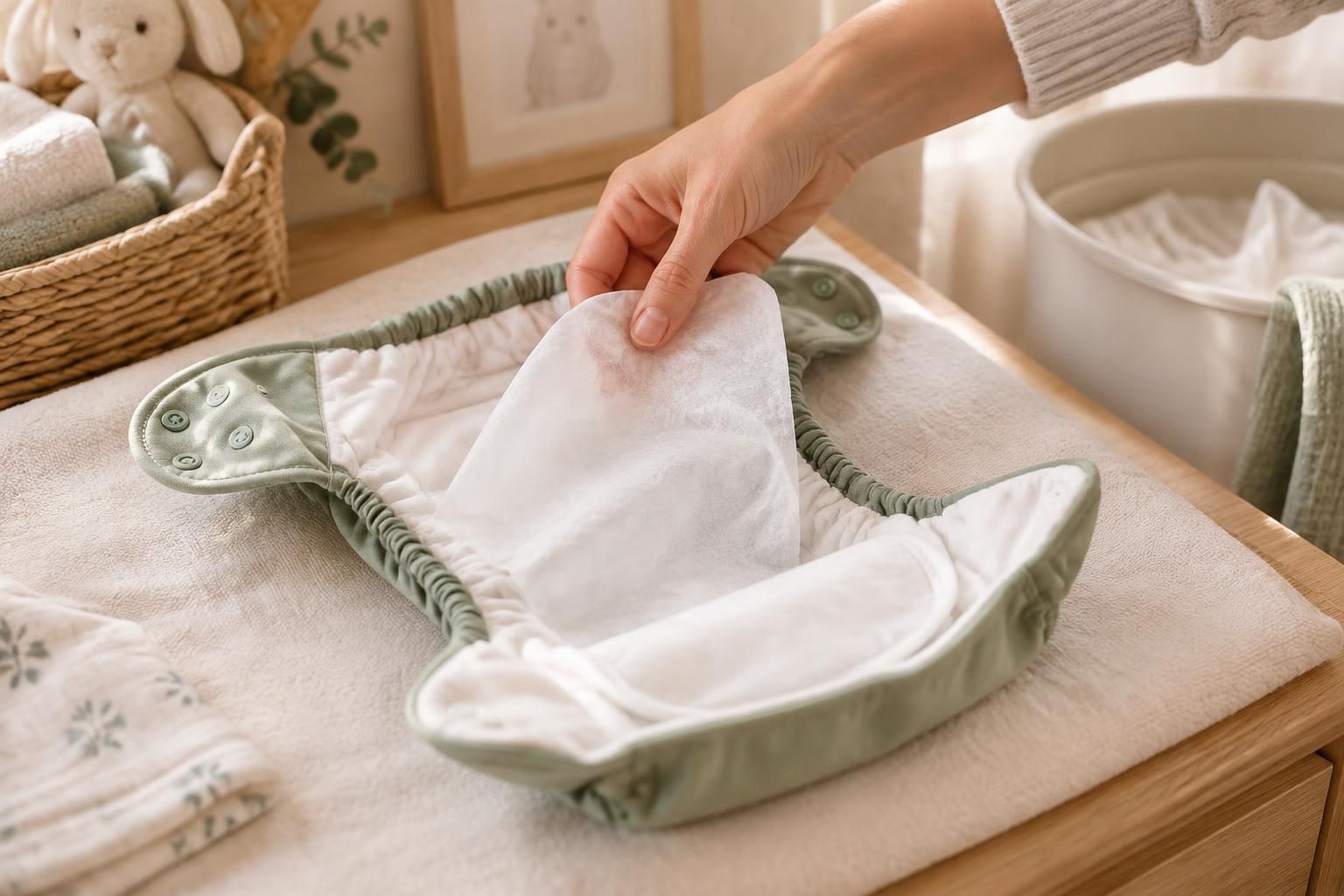
Slipped over the absorbent, in contact with the buttocks, the liner forms a diaper protection that mainly helps manage stool. During diaper changes, it is removed to dispose of solid waste or flush it in the toilet before washing the sheet if it is reusable.
It can also limit stains and prevent some greasy substances, like a diaper cream, from depositing directly on the diaper. However, it does not replace either the absorbent or an appropriate cream: its role is to facilitate the care of washable diapers, not to retain urine.
A practical accessory, but not mandatory
Some parents prefer to wash the diaper without adding a sheet, especially when the stool is easy to rinse. Others appreciate being able to remove the soiled liner in one quick motion: already full days do not need an extra step.
The liner can be particularly useful when stools are more frequent or difficult to clean. It then helps preserve the fabric and makes stool removal easier, without guaranteeing a perfectly clean diaper before washing.
Disposable or washable liner: what are the daily differences?
The disposable liner, often made of cellulose, is slipped into the diaper and removed after use. It is light and practical when on the go, but its environmental impact depends on its composition, manufacturing, and how it is disposed of.
A washable sheet, made of fleece or another textile material, is reused after machine washing. It requires some organization, but reduces waste and can become an economical option when used regularly.
| Type of liner | Advantages | To consider |
|---|---|---|
| Disposable cellulose | Lightweight, easy to carry, easy to remove | To be thrown away after use, unless otherwise indicated by manufacturer |
| Washable fleece | Reusable, soft, possible draining effect | Wash with diapers according to care instructions |
| Other washable textiles | Varied choice of materials and sensations | Check softness, fit, and washing instructions |
Be careful with flushing: biodegradable does not automatically mean compatible with plumbing. Unless explicitly stated by the manufacturer and clear local instructions, it is better to throw disposable liners in the trash.
A material chosen according to baby’s comfort
Fleece liners are appreciated for their soft touch and draining effect, which can give a drier sensation. Microfiber can also keep moisture away from the skin, but each baby reacts differently: in case of redness or discomfort, it is better to change material and consult a healthcare professional if necessary.
Wool and other natural textiles also exist, with specific care needs. Baby’s comfort depends as much on the material as on a well-fitted diaper that is changed regularly.
How to choose a liner suitable for reusable diapers?
Before purchasing, it is useful to think about when the liner will be used most: at home, on outings, with liquid stools, or to limit contact with greasy cream. It is not necessary to stick to a single model; several families combine different washable diaper accessories depending on the circumstances.
Thickness also matters. A thicker sheet can be easier to handle when stools are liquid or a cream is used, while a thin model stays discreet for daily use. In all cases, the liner should not interfere with diaper fitting.
- Check the size: the liner must cover the absorbent area without extending far beyond the diaper.
- Choose the material: prioritize a soft contact, taking into account baby’s skin sensitivity.
- Consider the use: washable suits changes at home, disposable can be handy on outings.
- Read the instructions: manufacturer’s indications specify washing, possible reuse, and disposal.
- Test simply: trying a few liners allows you to observe comfort and practicality before buying more.
A liner that is too narrow may leave the insert exposed, while one that is too large risks sticking out of the diaper. Correct adjustment keeps the sheet in place and avoids uncomfortable folds during movement.
Adapting the liner to changing stages
When a baby is breastfed, stools can be more liquid and harder to manage. A thick liner can then facilitate handling, even if washing the diaper remains necessary. With an older child, solid stools often come off the sheet more easily before machine washing.
When greasy cream is applied, check the diaper brand’s recommendations: some products can clog absorbent fibers. The liner offers a practical separation, but does not always constitute a sufficient barrier.
Using and washing liners without complicating the routine
The process is simple: lay the liner flat on the absorbent, directly under the buttocks, then adjust the diaper. When changing, remove the sheet without shaking it roughly and manage the stool according to the type of liner and manufacturer’s instructions.
A washable liner joins the diapers washing cycle, according to care instructions. For a disposable model, stools are eliminated according to local rules, and the liner goes to the trash unless a reliable indication explicitly authorizes another method.
Easy mistakes to avoid
The liner should not be placed under the absorbent: in this position, it no longer acts as a separation in contact with the skin. It should also not be considered an absorbent diaper or leave a soiled diaper too long.
Finally, the mentions “biodegradable” or “compostable” are not enough to determine where to throw a product. Packaging instructions and local rules prevail, especially to avoid clogging plumbing.
Frequently asked questions about reusable diaper liners
Is the reusable diaper liner indispensable?
No. It facilitates stool removal and can protect the diaper from stains, but a washable diaper can also be used without a liner.
Can a disposable liner be flushed down the toilet?
Not systematically. Biodegradable does not mean compatible with plumbing: only flush if the manufacturer explicitly allows it and local instructions permit it.
Does the liner protect baby’s skin from moisture?
Some liners, especially fleece, have a draining effect that provides a drier sensation. They do not replace an absorbent diaper nor regular changes.
Can a disposable liner be reused after a pee?
That depends on manufacturer’s indications. Many models are designed for single use; only wash or reuse if the instructions clearly allow it.