

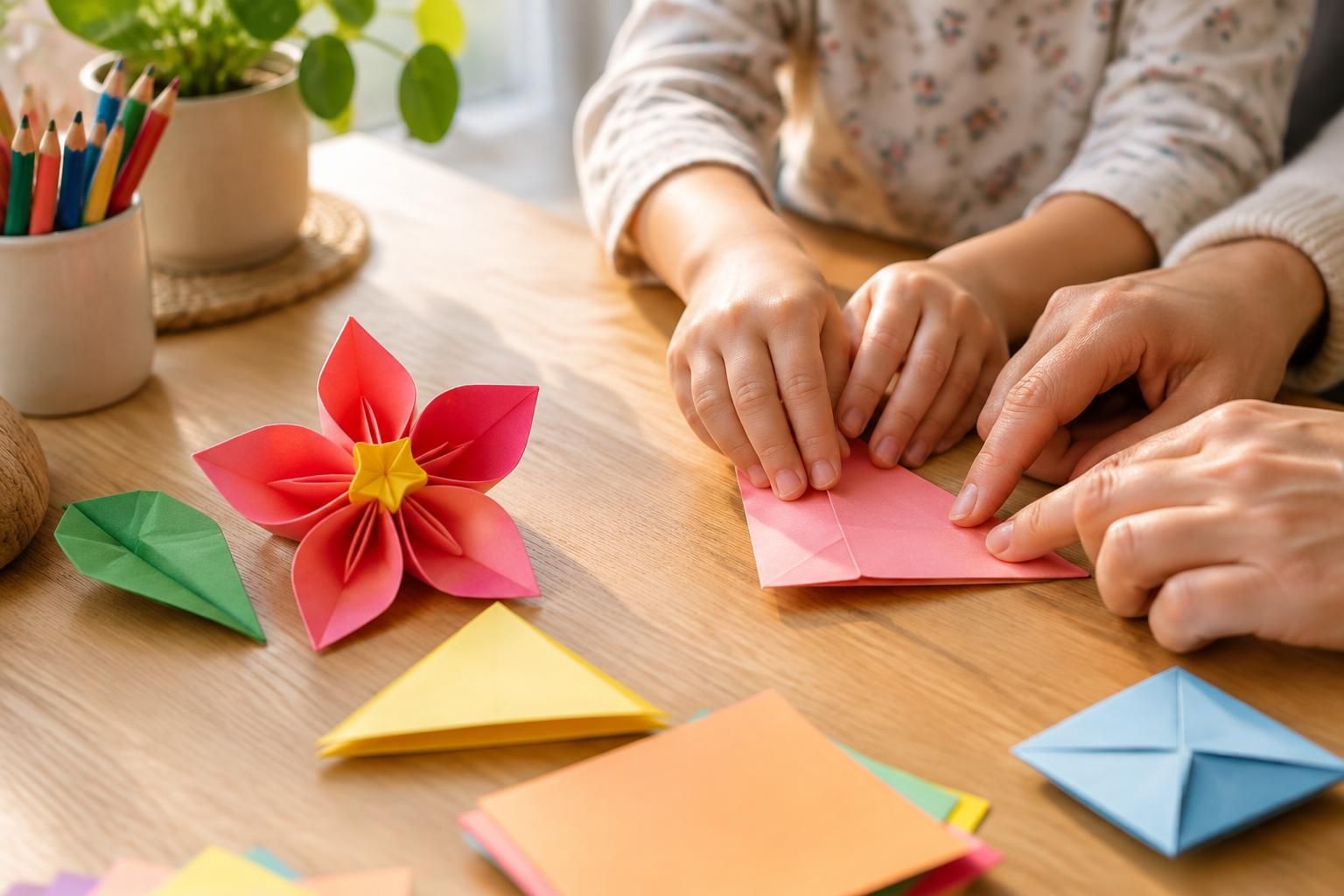
A square sheet, a few well-marked folds, and a bit of patience: the flower origami turns an ordinary afternoon into a lovely moment to share. Tulip, four-petal flower, or volumetric decoration, these easy models invite children to create with their hands, without complicated materials. And each paper flower keeps the memory of this little family workshop for a long time.
The article in brief
With a square of paper and simple motions, children discover the joy of folding while making a decoration that never wilts.
- The right paper : a light square makes the first folds easier.
- Models to start with : tulip and four-petal flower remain accessible.
- Calm gestures : creasing folds, then shaping without rushing.
- Decoration ideas : cards, bouquets, and garlands welcome your creations.
An easy fold is enough to share a creative activity and make a paper flower bloom.
Flower origami with children: an easy fold to start
When little hands discover paper folding, the goal is not to get a perfect flower on the first try. It is to take time to fold, unfold, then try again while having fun — because a slightly crooked corner quickly becomes an original petal.
This creative activity requires little material and fits easily into a rainy Wednesday or a quiet moment after school. It works fine motor skills, concentration, and imagination, without turning the living room table into a giant craft site.
A simple creative hobby, without complicated materials
To start, all you need is a square sheet of paper, a clear surface, and fingers ready to crease folds. Glue is usually not necessary: in traditional origami, the shape holds thanks to the folds. To attach a stem or complete a decoration, a small piece of adhesive tape can however be handy.
Offering a model suited to the age helps keep pleasure at the heart of the workshop. The youngest can choose colors and take part in the first folds, while an adult guides the steps requiring more precision.
Materials and paper to choose for a paper flower
Paper that is too thick resists under the fingers; too thin, it wrinkles easily. For a first kids’ DIY, lightweight origami paper is practical, but a square sheet cut from colored paper also works. The 15 × 15 cm size offers a good grip and makes folds visible.
Patterned paper brings a nice surprise to the result, while two-tone paper highlights the petals. No need to buy a full assortment: a few sheets retrieved from the craft drawer are enough to try.
| Material | Benefit | Ideal for |
|---|---|---|
| Lightweight origami paper | Folds easily and keeps sharp edges | First flowers and young children |
| Square colored sheet | Easy to find or prepare at home | A spontaneous workshop |
| Patterned paper | Gives decorative effect without extra | Cards and small gifts |
| Crayons or markers | Allow adding details after folding | Petal customization |
Origami tulip: steps for an easy fold
The tulip is a nice first model: it is made from a square and its result is easy to recognize. For a child discovering folding, it is better to show each movement slowly and allow time to align the corners well.
- Prepare the square: place a colored sheet in front of you, then fold it diagonally to form a triangle.
- Shape the sides: place the triangle’s tip upwards and lift the two lower corners, tilting them slightly outward to draw the petals.
- Finish the flower: fold a small piece of the bottom tip towards the back to get a cleaner base.
- Add a stem: fold a strip of green paper lengthwise, or use a paper straw, then fix it behind if needed.
- Add volume: gently open the petals with your fingers, without pulling the paper.
Are the folds not perfectly symmetrical? It’s not a problem: the flower keeps its charm, and each attempt helps better understand the motion. To vary the children’s activity, suggest making several tulips in different colors, then gathering them into a bouquet.
Some tips to avoid crooked folds
Before folding, the corners of the square must meet precisely. To crease a fold, a finger passage is enough; pressing very hard risks wrinkling the paper, especially with small hands. If a step proves delicate, the adult can show the movement on their own sheet rather than doing it for the child.
An origami workshop remains more pleasant when instructions are short: one movement at a time, then a pause to admire the result. It’s often at this moment that children invent names for flowers — and the floral creation takes its own direction.
Flower origami models by age and interest
After the tulip, a four-petal flower allows practicing repeating similar folds. Children who like precise steps can try more structured models, like the lotus, while beginners often prefer chaining several simple shapes to create a bouquet.
The right model is the one that makes you want to continue. A flat flower decorates a card easily; a more volumetric shape draws the eye on a table or in a garland.
| Model | Indicative level | Usage idea |
|---|---|---|
| Four-petal flower | Beginner | Card or gift tag |
| Tulip | Beginner | Bouquet or place card |
| Lotus | Intermediate | Table decoration |
| Volumetric flower | Intermediate | Garland or hanging decoration |
To find other ideas suited to small hands, creative activities to share with children can extend this moment beyond folded paper. And for a homemade gift, a flower slipped inside a card nicely completes a DIY gift for Grandmother’s Day.
Decorating and gifting your origami flowers
A paper flower easily finds its place in the home: assembled with a few others, it forms a lasting bouquet; alone, it adds a colorful touch to a card or gift wrap. Creations hung on a string can also become a light garland for a room or a party.
For a dinner or birthday, children can prepare place cards adorned with a small flower. Each chooses their color, adds a name, and takes part in the decoration: the result is personal, and the preparation is already a nice shared memory.
Paper creations do not replace fresh flowers, but they have a precious advantage: they do not wilt and can be reused. A simple way to give a second life to leftover sheets is to turn them into small decorations rather than letting them lie forgotten at the bottom of a drawer.
Frequently asked questions about easy flower origami
Which paper to choose to start flower origami?
A light and square paper, like classic origami paper, folds easily and suits first attempts. A 15 × 15 cm size is comfortable for learning.
Can you make a flower origami without glue?
Yes. Most simple models hold thanks to the folds. A small piece of adhesive tape can be used to fix a stem or an added decorative element.
Which origami flower is the easiest for a child?
The tulip and the four-petal flower are good models to start with: their steps are accessible and the result is easy to recognize.
From what age to suggest this creative activity?
A child can participate as soon as they like handling and folding paper, with an adult to show the movements. Models and level of help adapt to their ease.


