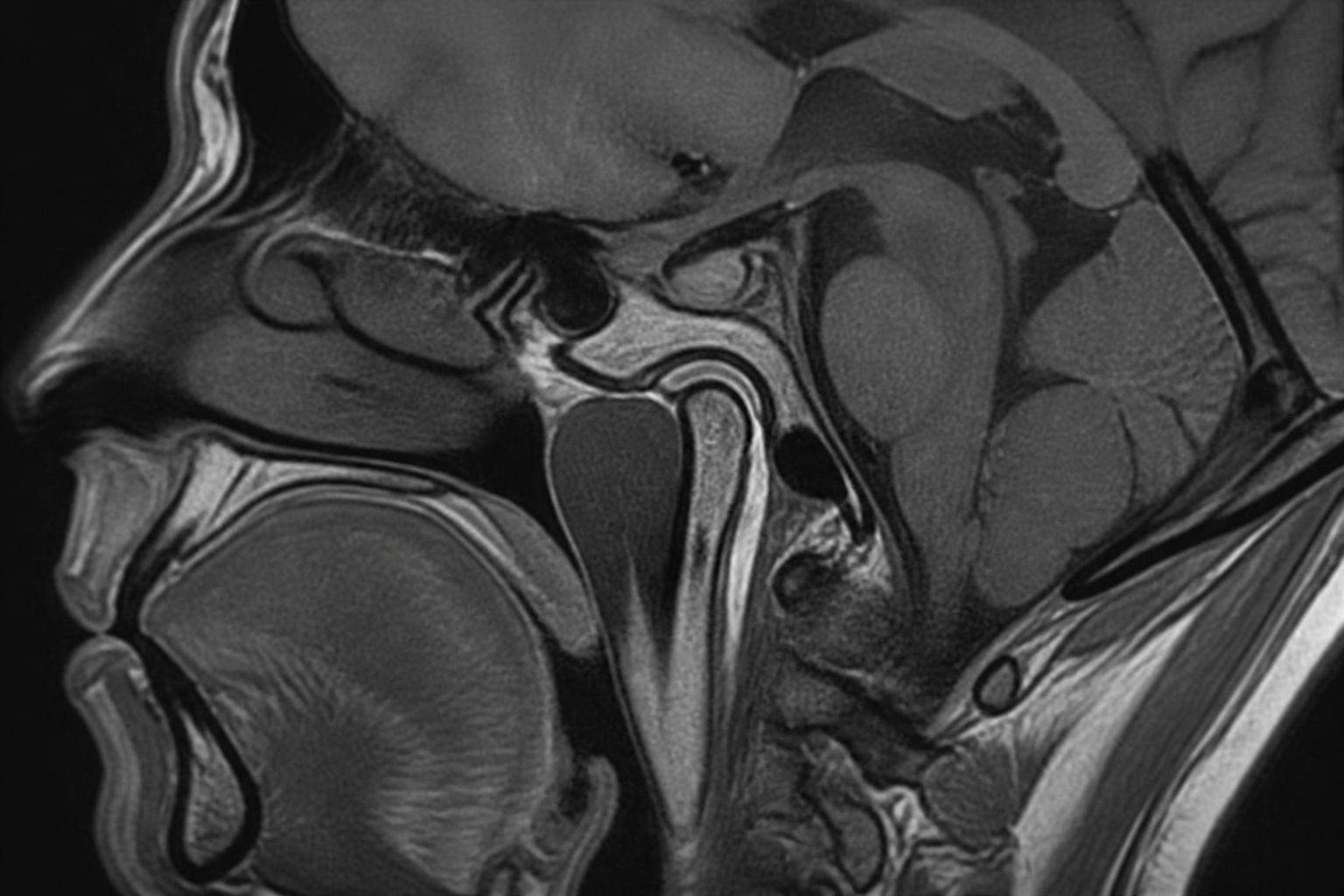
A jaw that clicks, discomfort in front of the ear, facial pain that returns when chewing… and suddenly, the TMJ comes into play. Behind this somewhat technical acronym lies a discreet but essential joint that connects the mandible to the temporal bone and accompanies every word, every bite, every yawn. Understanding its anatomy is already a better way to read the body’s signals, especially when the MRI clarifies what everyday movements do not always reveal.
The article in brief
When the TMJ makes itself noticed, it is not always a TMJ pathology. Often, it is a mix of fine mechanics, engaged muscles, and signals that must be calmly interpreted.
- Identifying the TMJ daily: A mobile joint located in front of the ear that coordinates the jaw
- Reading anatomy without getting lost: Condyle, temporal bone, articular disc, and ligaments work together
- Understanding the MRI: Medical imaging helps explore disc, bones, muscles, and tissues
- Distinguishing from disorders: Isolated noise, persistent pain, or locking don’t mean the same thing
This simple reading of the temporomandibular joint helps better understand symptoms and know when to seek advice.
To be completely transparent, the TMJ is part of those body areas we forget until they remind us with a little snap or a well-placed tension. And then, it’s impossible to pretend when speaking, chewing, or yawning becomes less natural. The good news is that once the basics are established, everything becomes clearer. An anatomical diagram makes sense, symptoms stop resembling a puzzle, and the MRI appears for what it really is: a useful medical imaging tool but never isolated from the rest.
Daily, the TMJ works tirelessly. It allows opening the mouth, adjusting chewing, participating in speech, and even managing side-to-side movements that make eating possible without thinking about it. When everything goes well, there’s no fanfare. When it malfunctions, however, the area becomes surprisingly talkative. It’s often then that the words temporomandibular joint, TMJ, mandible, and temporal bone start appearing in searches, just before questions multiply.
TMJ anatomy: a small joint by size, great by role
The TMJ is not a simple hinge. It links two sides that must move together, each in front of the ear, between the skull and the mandible. This ongoing cooperation explains why discomfort on one side can disrupt the whole movement. It’s therefore not just a moving bone, but a coordinated mechanism, both flexible and precise.
The heart of this mechanism is the meeting between the mandibular condyle and the temporal fossa. Between the two, the articular disc serves as a mediator by limiting direct friction and accompanying the sliding. Around it, the capsule and ligaments frame without blocking. The masticatory muscles provide the impulse and modulate force. A real little field team without which daily life would quickly become less smooth.
The key elements to recognize on a diagram
A good diagram helps understanding, provided you don’t mix everything up. The condyle is not the entire jaw, the temporal bone is not a simple passive surface, and the articular disc does not automatically become responsible for every crackle. This nuance matters, especially when a very clear drawing creates the illusion that you can conclude everything at a glance. In reality, anatomy primarily serves to set the right markers.
| Element | Main role | What to remember |
|---|---|---|
| Mandibular condyle | Mobile part of the mandible | It participates in opening, closing, and sliding |
| Temporal bone | Bony surface for support | It forms the other side of the joint |
| Articular disc | Movement interface | It accompanies movement and limits friction |
| Capsule and ligaments | Support and guidance | They stabilize without immobilizing |
| Masticatory muscles | Force and coordination | They move the jaw and can also contract excessively |
In real life, a joint can be silent for years then become sensitive after a period of stress, teeth clenching, or restless sleep. It’s no surprise that people then seek to understand the link between symptoms and structure. It is precisely here that examinations take their place.
Facial pain, clicking, and discomfort when chewing: when the TMJ makes itself heard
Pain near the ear, a deviated jaw, a sharp noise when opening… these signs do not all tell the same story. An isolated crackling without pain or locking doesn’t weigh the same as a clear limitation, discomfort during meals, or a jaw that remains locked. The key is not only the sound, but the context.
Facial pain may come from the TMJ, but also from muscles, teeth, or another local problem. This is why a professional focuses on when the discomfort appears, the triggering gestures, and the duration of symptoms. The body often gives very concrete clues: speaking for a long time, chewing on one side, yawning widely, clenching teeth at night… each situation tells a little more.
A simple example: a person can live normally all day, then feel jaw fatigue after a long meal. Another will hear a click when yawning but will have no pain. These are two different stories, even if both involve the same joint.
Signals that deserve real attention
Some signs simply require monitoring evolution. Others justify consulting, especially if discomfort settles in, intensifies, or disrupts daily functions. The goal is not to increase worry but to distinguish between an occasional noise and a situation that really begins to weigh.
- Isolated noise: usually harmless if stable and painless
- Pain near the ear: can concern the TMJ, muscles, or teeth
- Limited opening: becomes important if it disrupts eating and speaking
- Locked jaw: requires quick consultation, without attempts at manipulation
- Headaches or associated visual disturbances: go beyond simple local discomfort
In this area, precision reassures. The more concrete the description, the more useful the assessment. And frankly, between a “it pulls a little” and a “it locks at the end of opening for two weeks,” the medical discussion is very different.
MRI of the temporomandibular joint: what medical imaging can truly show
When MRI is mentioned, it is often used to see what the clinical exam can’t fully clarify. It is especially useful for observing the articular disc, neighboring tissues, muscles, and certain movement relationships. In short, it helps better understand internal mechanics, especially when doubt persists around a TMJ pathology.
But MRI is not an automatic answer to every jaw noise. It intervenes when the context justifies it, and always after a comprehensive evaluation. The professional may also discuss other exams depending on the question asked. The most important thing remains not to confuse a precise image with a complete diagnosis.
Why MRI is so useful in certain cases
Medical imaging allows visualization of fine structures, sometimes invisible on external exam. This can be precious when pain lasts, when the jaw locks, or when seeking to understand disc behavior during movement. MRI therefore does not replace consultation; it fits into a clinical story already well told.
| Examination | What it provides | Limit to keep in mind |
|---|---|---|
| Clinical exam | Links symptoms to movement and context | Does not see inside the joint |
| MRI | Analyzes the disc, muscles, and internal tissues | Does not replace the clinical story |
| CT scan or panoramic | Can specify bone or dental state | Does not answer all functional questions |
This explains why MRI is so often associated with TMJ in searches: it provides a finer reading, but it only has value when linked to real symptoms. A bit like a detailed house plan never replaces visiting the rooms, even if everything looks perfectly drawn.
Understanding the difference between normal joint and temporomandibular disorder
The term TMJ designates the joint itself. Temporomandibular disorder refers to a disturbed function, whether involving the joint, muscles, or a broader set. This distinction changes everything. It prevents turning a simple click into a diagnosis and also prevents trivializing discomfort that persists over time.
Temporary discomfort after a long meal doesn’t have the same meaning as pain that wakes you at night or a clearly limited opening. In the first case, the joint may have just been a bit overused. In the second, you need to go further. The body doesn’t always dramatize but never speaks for nothing.
To be clearer when consulting, some guidelines save time:
- Name the action: opening, chewing, yawning, speaking, or clenching
- Specify the moment: beginning, end of movement, or after effort
- Describe the duration: occasional, recurrent, or established
- Note the impact: meals, sleep, speech, dental hygiene
This way of observing does not replace medical advice, but it prepares it very well. And often, that’s already a lot: less ambiguity, fewer rushed interpretations, more clarity.
When TMJ anatomy helps better communicate with the healthcare professional
Understanding the TMJ doesn’t mean becoming a specialist. It mainly means learning to name what happens, without overinterpreting or minimizing. Saying that a noise occurs when yawning, that pain appears during chewing, or that opening is less comfortable than before changes the quality of the discussion. It helps to direct the exam and sometimes to avoid unnecessary fears.
This approach is especially useful when symptoms revolve around the jaw, face, or temple. You get better bearings, consult more appropriately, and also more easily accept that a clinical exam may be sufficient in some cases, while MRI will be reserved for others. In 2026 as before, the best medicine is often the one that starts with simple facts, well told.
To keep this thread clear, two resources can also help take a step back on daily life and organization because a lighter mind often helps useful information flow better: smart ideas for a small budget and a simple board game to play with family. Nothing to do with the jaw, of course, but sometimes a little mental breathing helps better listen to your body.
In the end, the essential is simple: the TMJ is a mobile, fine, coordinated joint, and MRI becomes precious when you need to look beyond the simple noise. The nuance is there, and it changes everything.
TMJ and temporomandibular joint, is it the same thing?
Yes. TMJ is simply the acronym for the temporomandibular joint, the joint located in front of the ear that connects the mandible to the temporal bone.
Does a jaw click mean there is a TMJ pathology?
Not necessarily. An isolated noise without pain or locking may remain harmless, whereas a painful click or one associated with a limitation deserves more attention.
What is the purpose of MRI in the study of the TMJ?
MRI allows exploration of the articular disc, muscles, and some internal tissues. It is useful when the clinical context raises a real question, but it does not replace the clinical exam.
Why can facial pain be related to the jaw?
Because the TMJ is located near the ear, teeth, and masticatory muscles. Facial pain can therefore come from several sources that must be carefully distinguished.
What to do if the jaw remains locked open?
You should not try to put it back in place yourself. A locked jaw, especially if it prevents eating, drinking, or closing the mouth, requires prompt medical advice.