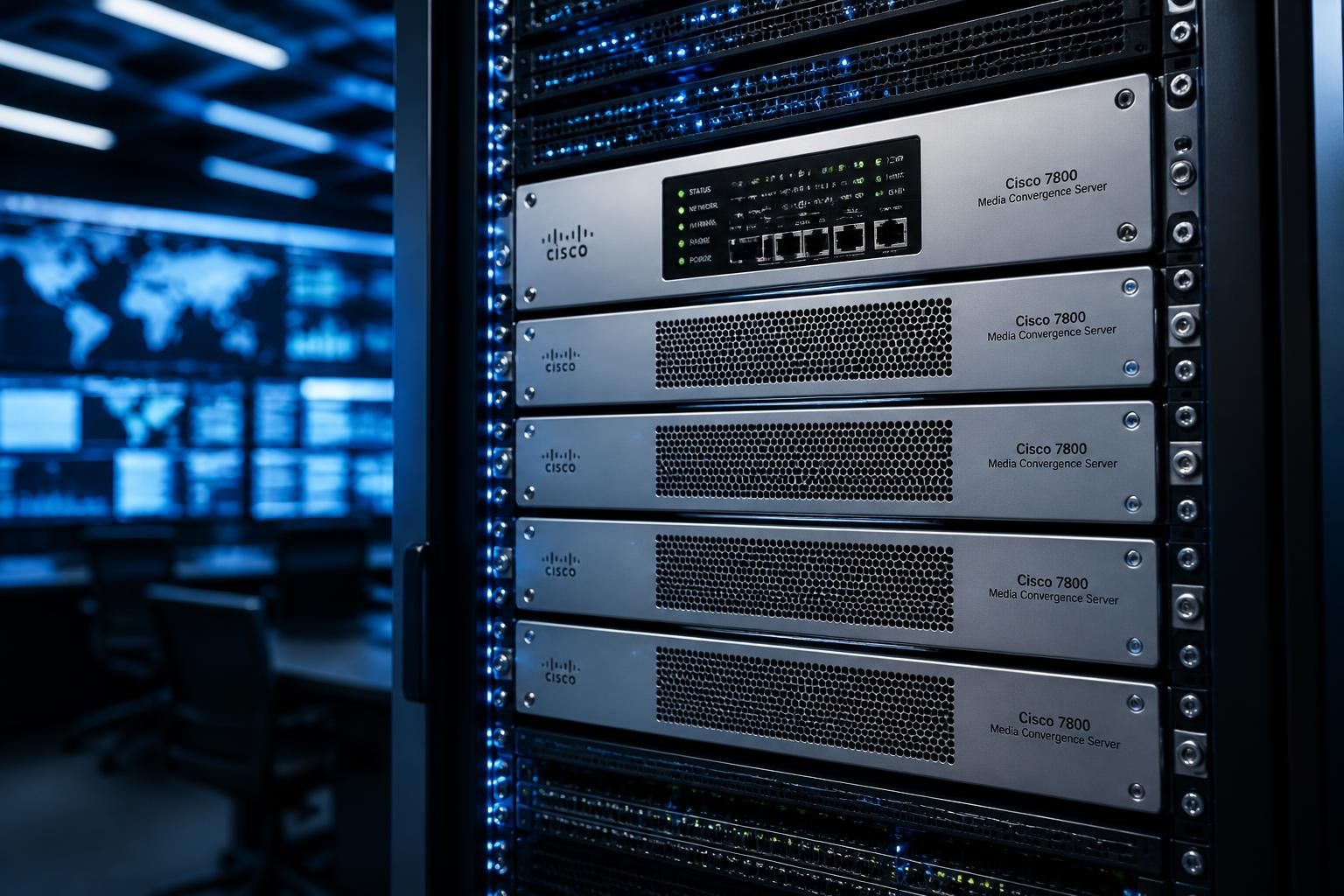
In a company, everything often happens behind the scenes: calls that go through smoothly, meetings that start on time, data that flows without friction. The Media Convergence Server Cisco has long embodied this promise by bringing together voice, video, and communication services in an architecture designed for enterprise networks. With the 7800 models, this logic takes on a more readable form: a media server designed to support unified communications and strengthen an IT infrastructure without complicating the teams’ lives. Here is what to remember to understand its operation and uses in a professional context.
The article in brief
The Cisco servers of the 7800 range marked an important step in media convergence in business. Their logic remains relevant today to understand how to build reliable and scalable communications.
- Architecture designed for voice: centralizing communication services on enterprise network
- Clear 7800 range: from entry-level model to high-capacity server
- Choice according to use: rack, redundancy, storage, and power adapted
- Useful reading in 2026: understand the basics of modern unified communications
A clear reference point to link Cisco heritage, business needs, and IT infrastructure logic.
In a server room, it’s not all about raw power. What’s mainly needed is coherence, stability, and the ability to support real use cases, from telephone systems to internal videoconferencing. That is exactly where the Media Convergence Server from Cisco found its place: a technical foundation intended to make several communication blocks interact within the same environment, with a very gradual upgrade according to company size.
The principle is simple to understand, even if the engineering behind it is not always so. The server hosts services related to unified communications, relying on components designed for availability, continuity, and load management. At the time of the first deployments, this already made it possible to avoid stacking scattered systems. Even today, this logic appeals to IT management seeking clear, robust, and easy-to-scale environments.
Media Convergence Server Cisco: a media server serving unified communications
The term may seem technical, almost a bit cold. Yet behind this name lies a very concrete idea: bringing together on the same platform the functions that make telephony, conferences, and certain media services operate within a company. The Cisco media server acts as an anchor point for media convergence, reducing tool dispersion and facilitating their administration.
In a professional context, this approach changes many things. When calls, messaging, and video rely on a common architecture, teams gain clarity. IT managers have a simpler framework for supervising, securing, and sizing usage. It is often there that you can tell if a solution holds up: not in the brochure, but in the daily life of a support service wanting to avoid surprise outages on a Monday morning.
How this Cisco architecture works in an enterprise network
The operation is based on a centralization logic. The server handles essential services related to voice and exchanges, while integrating into existing enterprise networks. It then becomes an intermediary link between terminals, communication applications, and end users.
Concretely, this makes it possible to structure flows, better distribute resources, and guarantee more regular availability. In a growing SME as in a multisite group, this technical base avoids the headache of scattered installations. And honestly, between us, when a system can be supervised more cleanly, on-call nights already seem a bit shorter.
Why IT teams appreciated this convergence logic
The strength of this approach came from its ability to reduce silos. Instead of managing several devices separately for voice, video, or some collaboration functions, the company relied on a more unified base. This simplified service maintenance, supervision, and evolution, while bringing better overall coherence to the IT infrastructure.
This coherence matters enormously in environments where several sites must remain connected without creating technical confusion. One headquarters, two agencies, a hybrid team, a few IP phones, a centralized switchboard: the scenario is almost normal in 2026, but the promise remains the same. Make information flow smoothly, with minimal friction and maximum continuity.
Cisco 7800 Models: a range designed for very different enterprise needs
The 7800 models family is not a single block. It was designed to meet several levels of requirements, from entry-level servers to more robust platforms intended for heavier loads. This gradation is important because it shows Cisco did not offer a fixed model, but a series capable of supporting the growth of an organization.
In fact, this allowed a company to start with a modest configuration and then evolve according to its needs. An administrative service with a limited fleet had different expectations than a call center or a group distributed over several sites. This is precisely where the range made sense: choosing the right capacity level, without oversizing or underestimating usage.
| Model | Positioning | Main asset | Typical use |
|---|---|---|---|
| 7815 | Entry-level | Simple base to start | Small structures or initial deployments |
| 7825 | Rackable entry-level | Compact format in 1 RU | Companies seeking a discreet server |
| 7835 | Mid-range | Enhanced availability | Active sites with continuous needs |
| 7845 | High-end | Power and redundancy | Higher loads and critical services |
| 7855 / 7865 | Very high capacity | Denser architecture | Demanding environments and large volume |
The differences that really mattered between models
Beyond the names, it was mainly the hardware details that made the difference. Some models offered a tower format, others a 1 RU rack format, easier to integrate into a standard cabinet. The most advanced versions added more disks, redundancy, and processing capacity, which changes everything when the service must never stop.
The logic was therefore very pragmatic: adapt the machine to the volume of users, the expected availability level, and site organization. A company handling critical communications does not have the same priorities as a lighter office. And it is often in this kind of choice that the quality of a deployment is decided over the long term.
Technical elements that strengthened reliability
On the most solid versions, the presence of hot-swappable disks, redundant fans, and dual power supplies reinforced service continuity. It’s not spectacular on screen, but it is decisive when an organization relies on its daily communications. A component can fail without taking down the entire platform, and it is precisely this kind of detail that reassures technical managers.
In a corporate setting, reliability is not measured only by displayed power. It is read in the capacity to absorb the unexpected without interrupting activity. This is where the 7800 models left a lasting mark: a balance between robustness, range hierarchy, and service logic.
Criteria to consider before choosing a Cisco server for the company
Choosing a server from this family already required a true reading of needs. You had to look at the number of users, the criticality level of calls, available rack space, and availability requirements. Nothing was left to chance, because a successful communication architecture is always the one that fits the field, not the one that impresses only on paper.
A short list helps to clarify priorities, especially when several services must coexist on the same technical foundation:
- User volume: size the real load rather than overestimate
- Installation format: tower or rack depending on available space
- Level of redundancy: secure power supply, ventilation, and storage
- Expected growth: anticipate the scaling of communications
- Maintenance constraints: simplify daily operations
This type of trade-off remains very relevant in 2026, even if architectures have evolved a lot since then. Companies are still seeking solutions combining stability, sobriety, and adaptability. And deep down, this is what makes a technical platform’s lasting value: its ability to support change without losing focus.
What the history of the 7800 range still teaches us today
The 7800 range reminds us that a good solution is not necessarily the newest, but often the one that understood well the need it addresses. By linking voice, video, and administration in a unified logic, Cisco laid a foundation that influenced many later architectures. It’s not just a matter of hardware; it’s a way of thinking about communication as a global system.
For a company, this understanding remains valuable. It helps better grasp why resilience, modularity, and operational clarity remain major criteria in infrastructure choices. And when technical tools know how to be forgotten, it is often a sign that they exactly fulfill their role.
What was a Media Convergence Server Cisco used for?
It centralized communication services such as voice and certain multimedia uses, in order to support unified communications in an enterprise network.
Did the 7800 models suit all company sizes?
The range covered several levels, from entry-level models to more powerful versions, enabling the server to be adapted to the number of users and technical constraints.
Why was the rack format sought after?
The rack format facilitated integration into a server cabinet, optimized space, and simplified the organization of a professional IT infrastructure.
Do these servers still have relevance in 2026?
Yes, especially for understanding the basics of media convergence, high availability, and structuring unified communications in enterprises.
To go further, the Media Convergence Server Cisco remains a great entry point to understand how companies have long sought to converge technology, voice, and service continuity within the same logic of efficiency.