


When the question of conceiving twins arises, we often hear about different postures or “sexual positions” supposedly favoring a multiple pregnancy. These tips, often passed down by word of mouth, verge on the realm of myth and family folklore. Yet, behind these preconceived ideas, what does scientific reality say? The formation of monozygotic or dizygotic twins results from very specific biological processes, influenced by genetic, hormonal, and environmental factors, far from the simple position adopted during fertilization.
The article in brief
The desire to have twins sparks dreams and legends. Beyond myths about sexual positions, this article explores the science underlying twin pregnancies and their true factors.
- Distinguishing identical and fraternal twins: Understanding the mechanisms of monozygotic and dizygotic twinning
- Factors influencing probability: Role of maternal age, genetics, and ethnic origin
- Diet and treatments: Controversial impact of dairy products and vitamin supplements
- Sexual positions and myths: No scientific evidence confirming their influence on multiple pregnancy
Understanding the science behind twin conception helps to demystify myths and move forward calmly with your family planning.
Understanding multiple pregnancy: the true foundations of twinning
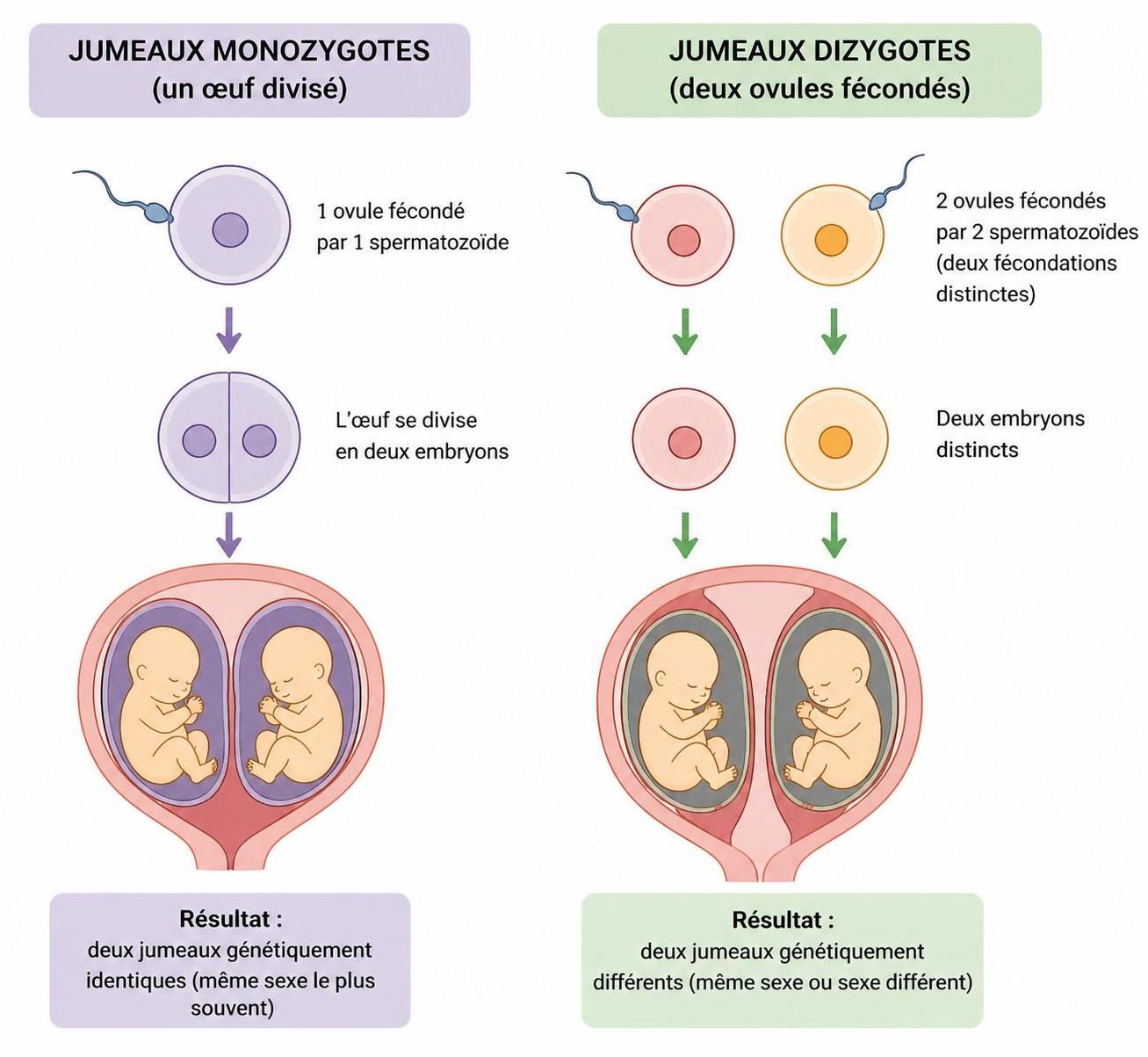
Nature offers two main pathways for a multiple pregnancy: monozygotic twins, coming from the division of a fertilized egg, and dizygotic twins, resulting from the simultaneous fertilization of two distinct eggs. The former share an almost identical genetic heritage, while the latter resemble two siblings born at the same time. This distinction is essential to untangle myths and scientific reality.
Monozygotic twins represent a rare phenomenon, stable regardless of population or maternal age, with about 3.5 to 4.5 births per 1000. Conversely, the frequency of dizygotic twins varies more according to age, previous pregnancies, and genetic factors.
Biological factors that increase the probability of dizygotic pregnancy
Multiple ovulation is the cornerstone of dizygotic pregnancy. Several elements promote this natural phenomenon:
- Maternal age : Women approaching 36-37 years see their rate of dizygotic twins increase, correlated with a rise in FSH hormone which stimulates multiple ovulations
- Number of previous pregnancies : The more pregnancies a woman has had, the higher the risk of dizygotic twins, although this factor is secondary
- Family predisposition : Some families carry genes favoring the release of multiple eggs
- Ethnic origin : Rates are observed to be twice as high in sub-Saharan Africa compared to Europe, and lower in Asia
The limits of sexual positions in the myth of twins
A gentle folklore often surrounds the “ideal sexual position” to conceive twins. However, no scientific study supports the impact of positions on fertilization or the phenomenon of double ovulation. Fertilization depends on the random meeting between the egg and sperm, in an environment governed by hormonal and genetic factors.
What makes sense is rather what you read in family experiences around twins or advice for living multiple parenthood well. For those wishing to go further in well-being during pregnancy, considering ergonomics with a nursing pillow can really change life!
Diet, supplementation, and ovarian stimulation: what science says
What if the key came rather from what we put on our plate? Study results remain reserved, but some intriguing leads are worth following:
- Dairy products : Some American studies suggest an increase in twin pregnancy rates via indirect stimulation linked to hormones in milk
- Vitamin B9 supplementation : Folic acid, well known for preventing neural tube defects, could also slightly increase the chances of twins
- Fertility treatments : In particular in vitro fertilization (IVF) and ART techniques, which promote the birth of dizygotic twins by ovarian stimulation or transfer of multiple embryos
| Factor | Effect on twin rate | Type of twins influenced |
|---|---|---|
| Maternal age (36-37 years) | Significant increase | Dizygotic |
| Pregnancy history | Moderate increase | Dizygotic |
| Genetic predisposition | Variable by family | Dizygotic |
| Fertility treatments (IVF) | Strong increase | Dizygotic and sometimes monozygotic |
| Diet (dairy products) | Potential controversial increase | Dizygotic |
The growing spread of artificial fertilization has changed the landscape of pregnancies worldwide, notably increasing the proportion of twin pregnancies. But this phenomenon remains subject to strict medical frameworks.
Does sexual position influence the probability of having twins?
No, there is no scientific evidence that a particular position favors the conception of twins. Fertilization depends on complex biological factors.
What are the differences between monozygotic and dizygotic twins?
Monozygotic twins come from a single divided egg, sharing the same genetic heritage. Dizygotic twins come from two different eggs, having a distinct genetic heritage.
What factors increase the chances of having twins?
Advanced maternal age, family history, ethnic origin, vitamin B9 supplementation, and fertility treatments are the main known factors.
Can diet influence twinning?
Some studies mention a potential role of dairy products and vitamin B9, but evidence remains mixed and requires further research.
Do fertility treatments increase twin births?
Yes, particularly IVF, which can lead to the simultaneous birth of dizygotic twins due to ovarian stimulation or transfer of multiple embryos.


