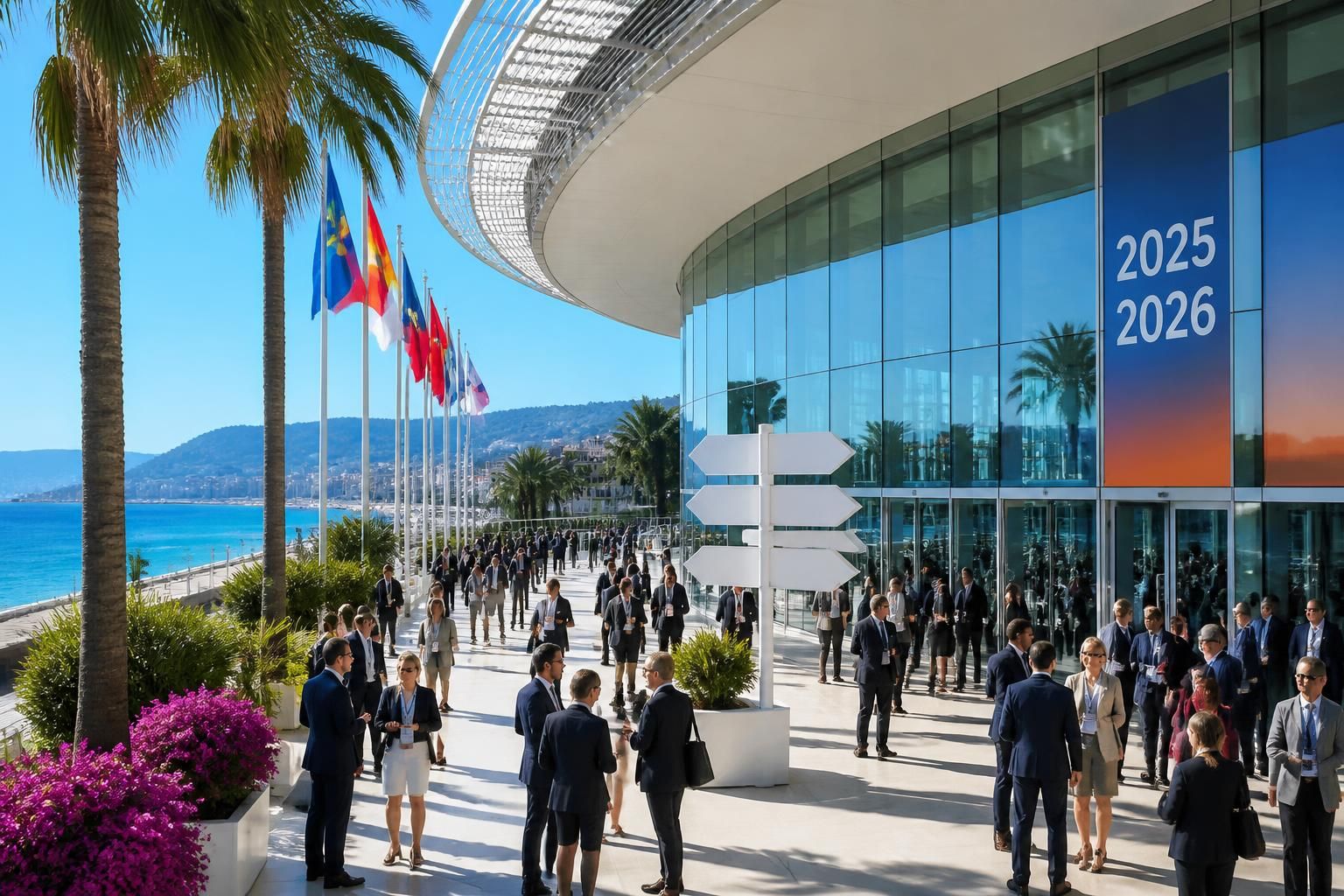
In Nice, the news of major meetings is not just a simple trade show agenda. Between the UNOC 3 Conference of 2025, its highly structured diplomatic sessions, and the appointments that extend the momentum in 2026, the city establishes itself as a rallying point for those who follow the great debates on the ocean, innovation, and concrete transitions. The dates, the themes, and the program shape an event that is at once political, scientific, and deeply embodied, with participants coming together to cross their visions in a setting that knows how to capture attention. And frankly, when Nice gets moving, even the most serious files take on a slightly more vibrant tone.
The article in brief
Nice will host a major international conference on the ocean in 2025, with a dense and highly anticipated program. In 2026, the momentum continues around the same issues: governance, coastal protection, and mobilization of stakeholders.
- Key dates to remember: UNOC 3 takes place from June 9 to 13, 2025, in Nice
- Priority themes: climate, plastics, overfishing, and marine protected areas
- Extended program: official sessions, scientific forums, and economic meetings
- Why follow Nice: the city concentrates debates, visibility, and international participants
An appointment that goes beyond a simple event to influence upcoming decisions.
To be completely transparent, this type of meeting is not read simply as a series of dates. It is understood as a snapshot of the moment: a world that knows the ocean is warming, coasts are eroding, plastics are overflowing, and the responses must be collective, not decorative. In Nice, the Conference has precisely served as a sounding board for these urgencies, with highly visible staging in the city, but above all with exchanges where diplomats, scientists, companies, and civil society have been brought together around a common goal.
What also stands out is the way the subject is inscribed in the long term. In 2025, UNOC 3 laid very concrete groundwork, and in 2026, the issues remain pressing: how to accelerate marine protection, how to monitor commitments made in Nice, and how to transform announcements into tangible actions? A bit like that notebook you open telling yourself you will write everything neatly, then end up filling it with arrows, reminders, and small everyday urgencies. Except here, the stake is global.
Nice 2025: the major dates of the Ocean Conference
The third United Nations Ocean Conference was held from June 9 to 13, 2025 at the Nicea Congress Center, in the port district. Organized by France and Costa Rica, it brought together UN member states around SDG 14, dedicated to aquatic life, with a simple ambition to state but difficult to achieve: to make ocean protection an international priority genuinely followed by effects.
Even before the official opening, Nice lived at the pace of preparations. A drone show illuminated the sky on June 6, while an ocean-themed anthem was performed on June 7. And if one seeks to understand the scope of such an event, it is necessary to look at this build-up: the city does not just host, it installs an atmosphere, almost like a large editorial room where everyone works simultaneously on the same subject.
A dense schedule designed to facilitate dialogue among stakeholders
The core program alternated plenary sessions and more specialized meetings. Mornings and afternoons allowed governments, scientists, international organizations, NGOs, and economic actors to intersect. It is precisely this mix that gives strength to the Conference: when everyone speaks in their bubble, progress remains modest; when exchanges confront one another, solutions gain prominence.
Before UNOC, three preliminary meetings also structured the week, notably the One Ocean Science Congress in Nice, the blue economy forum in Monaco, and a summit dedicated to coastal resilience. In short, the subject was not treated in isolation, but within a complete ecosystem. This is often where the difference lies between a major event and a true moment of influence.
For those following major international meetings, one detail matters greatly: calendar readability. Here, the dates allowed the identification of key moments, while the program revealed the real underlying issues. It is this precise mesh that transforms a week of conferences into a useful sequence for decision-makers as well as the general public.
Key themes addressed in Nice in 2025
The discussions revolved around very concrete issues. Ocean warming, overfishing, plastic pollution, coastal erosion, and deep-sea exploitation dominated the exchanges. Not surprising: the Mediterranean recorded a record temperature of 28.9 °C in summer 2024, a harsh reminder that warning signals no longer concern the future but the present.
In this context, Nice served as a stage for highly visible diplomatic mobilization. On June 10, 96 countries signed the Nice Call for an ambitious treaty on plastics. The idea was simple: if the planet produces waste at the speed of a poorly adjusted machine, it is finally necessary to impose a serious common framework. And here, let’s be honest among ourselves, grand declarations are no longer enough; measurable commitments are what count.
| Theme | Main issue | What Nice highlighted |
|---|---|---|
| Marine warming | Limit effects of an overheating sea | Climate emergency and coastal adaptation |
| Plastic pollution | Reduce ocean waste | Support for a binding treaty |
| Overfishing | Preserve fishery resources | Debate on destructive practices |
| Marine protected areas | Expand conservation zones | Goal for global-scale progression |
Alongside these major themes, another question gained prominence: that of the participants most exposed to climate change, notably small island states. Their place in the global governance of oceans is not a diplomatic detail. On the contrary, it is a condition of credibility because those who experience the rising risks daily often know very quickly what works and what is just a somewhat too polished discourse.
Commitments that go beyond symbolism
The Conference also left behind several strong lines of action. Among them: the expansion of marine protected areas, progress toward a moratorium on deep-sea mining, and the rise of a coalition for a quieter ocean. In other words, the discussions led to very concrete indicators for the coming months and years.
In a follow-up logic, the dynamics launched in Nice remain particularly visible in 2026, notably regarding ratifications related to the BBNJ treaty and upcoming diplomatic steps. This is far from a simple “we’ll talk again later.” The calendar now provides direction, and this is precisely what is expected from a Conference of this magnitude.
To further this reading, a detour through related topics can also shed light on how major events are narrated and relayed in mass media, like Léa Salamé’s media journey or Alexandra Blanc’s revelations. It’s not the same universe, of course, but the same mechanism is found: an event becomes striking when it is embodied in faces, stories, and clear landmarks.
Which program to follow in Nice between 2025 and 2026?
For those looking to identify good slots, the most useful approach is to reason in blocks. First, the official week in June 2025, with the opening, plenary sessions, and signings. Then, the 2026 aftermath, where implementation is monitored, new meetings take place, and the next international steps are planned. The keyword here is continuity.
Nice also remains a destination that can host large crowds without losing its energy. The drone show gathered nearly 150,000 spectators, and the Whale attracted a large audience. In the city, this effervescence gave a nearly festive color to a subject that is nevertheless serious. As it happens, even the most serious files benefit from being made visible and accessible.
- June 9, 2025: official opening and speeches from leaders
- June 10, 2025: signing of the Nice Call on plastics
- Mid-June 2025: debates on marine protected areas and governance
- In 2026: monitoring commitments and upcoming diplomatic steps
This breakdown is valuable to avoid getting lost in the flood of announcements. Between the program, meeting spaces, and sessions dedicated to economic or scientific stakeholders, the event worked like a large collective clock. Each key moment had its usefulness, and each sequence its audience.
At this stage, it’s hard not to think about how some meetings know how to create a shared memory, a bit like a neighborhood party that becomes a family landmark. Except here, the stakes touch the entire planet, and that changes everything. To follow the movement, it is better to look at decisions, not just announcements.
In the same spirit, readers who like to spot societal topics treated in a lively way can also browse Christmas ideas for bloggers or some landmarks around volleyball rules. Again, the logic is the same: good content makes a subject immediately readable, without oversimplifying it.
Why does Nice establish itself as a city of international conferences
Nice not only hosted a Conference; it confirmed a position. Its new congress center, its opening onto the Mediterranean, and its ability to orchestrate major meetings give it a real advantage. When a city manages to combine accessibility, visibility, and quality of reception, it naturally becomes an event magnet.
And then there is the image. A city that talks about the ocean by the sea is no coincidence. The setting reinforces the message, a bit like those beautiful family tables where you think the dish might have been good elsewhere, but it has something extra because it’s shared at the right place, at the right time.
In 2026, this ability to host and sustain dynamics will be even more decisive. Ocean issues do not stop at one week of meetings; they require perseverance, relays, and regular follow-ups. And it is often what distinguishes a spectacular event from a truly useful meeting: the trace it leaves after the spotlights.
What are the dates of the Conference in Nice?
UNOC 3 was held from June 9 to 13, 2025 at the Nicea Congress Center, with several preliminary events starting June 3.
What topics dominated the discussions?
The main themes concerned ocean warming, plastic pollution, overfishing, marine protected areas, and coastal erosion.
Why is Nice still discussed in 2026?
Because the commitments made during the Conference must be followed up over time, notably on plastics, the high seas, and ocean governance.
Was the Conference open to the general public?
Yes, several key moments attracted a large public in Nice, notably the drone show and some mediation spaces like the Whale.