

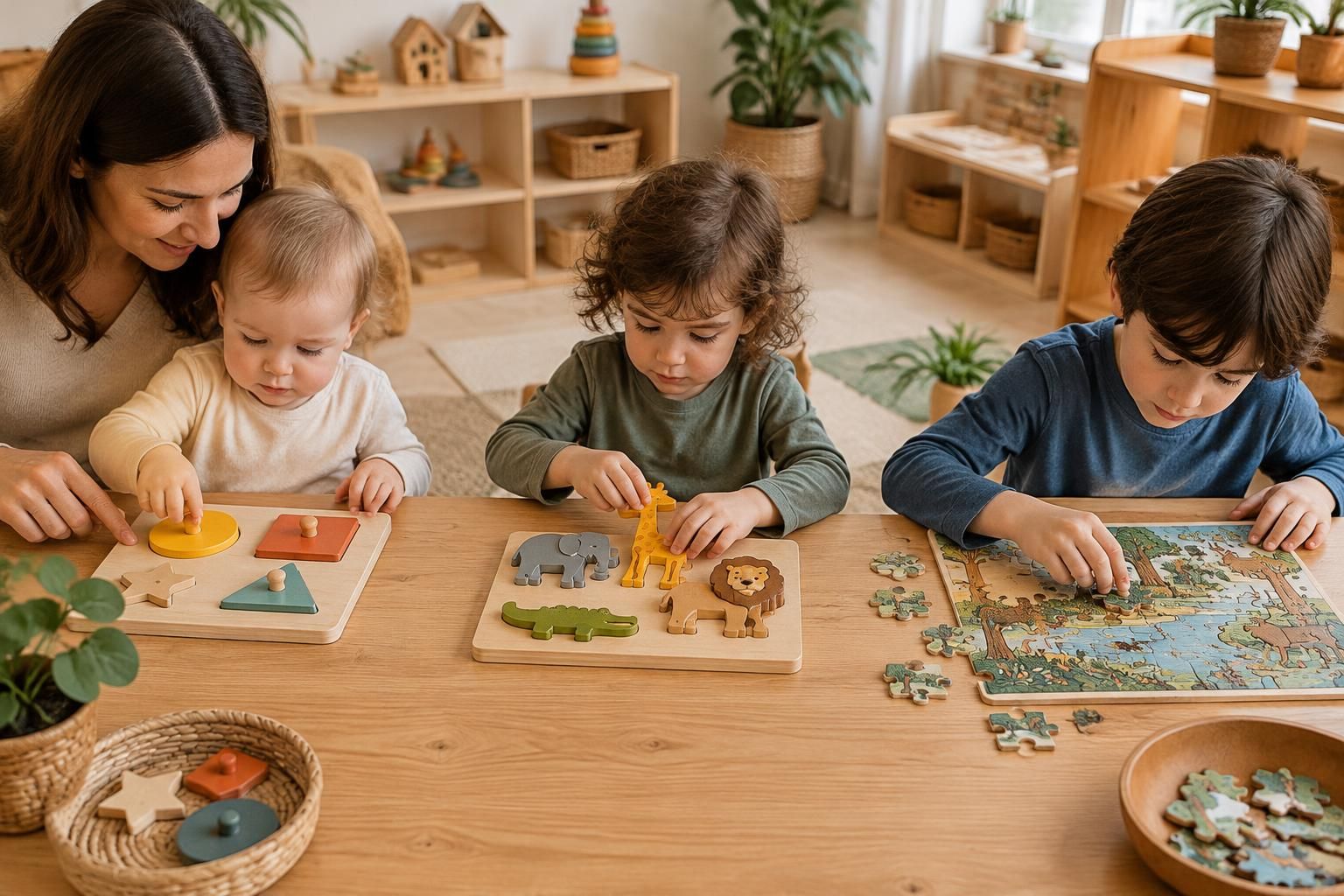
Choosing a Montessori puzzle is not about looking for the most complicated model, but the one that makes the child want to try again. The right benchmark is their age, of course, but also their movements, curiosity, and the pleasure they take in handling it. From simple shapes to fit in to more elaborate puzzles, each step can support the child’s development without turning the game into an exercise.
The article in brief
From easy-to-grasp shapes to puzzles with several pieces, the choices evolve with the child’s abilities and desires. Some simple guidelines help offer a stimulating game without skipping steps.
- The first gestures: From 12 months, favor large pieces that are easy to grasp and place.
- The right level: Adjust the number of pieces according to autonomy, not just age.
- Learning: Handling develops fine motor skills, observation, and eye-hand coordination.
- Safety: Check materials, finishes, and age recommendations before each purchase.
To remember: a suitable puzzle invites the child to try again with pleasure and confidence.
Which Montessori puzzle to choose according to the child’s age?
A toddler often starts by removing a piece before understanding how to put it back. This is already a wonderful exploration: they observe the shape, test their movement, and discover that an action can produce a result. A well-chosen Montessori puzzle accompanies this progression, without asking the child to succeed on the first try.
Age indications provide a guideline, but do not summarize a child’s skills. Lina, for example, may love fitting simple shapes while losing interest in a puzzle richer in details. The right choice is the one that makes her want to come back to it, with a small challenge within reach.
The stages of Montessori puzzles, from 1 to 6 years and beyond
Abilities develop at their own pace: handling, contour observation, and patience build with experience. The age ranges below are therefore flexible guidelines, to be adapted according to each child’s interest and ease.
| Indicative age | Recommended format | What the child explores |
|---|---|---|
| Around 12 to 18 months | Inset puzzle, large handles, 2 to 4 shapes | Grasping, removing, and replacing pieces |
| Around 18 months to 2 years | Simple shapes, about 3 to 6 pieces | Matching a piece to its spot |
| Around 2 to 3 years | Wooden puzzles or frames of 4 to 12 pieces | Observing contours and assembling |
| Around 3 to 5 years | Illustrated puzzles of 12 to 30 pieces | Organizing a strategy and persevering |
| From 5 or 6 years | More detailed puzzles, 30 pieces or more | Anticipating, comparing, and solving a challenge |
These numbers are not targets to be reached on a precise date. If the child enjoys a simpler puzzle, it is better to respect their momentum than to offer a frustrating model just because of their age.
From 12 to 24 months: start with an inset puzzle
At this age, thick and easy-to-grasp pieces are often the most suitable. An inset puzzle with some familiar shapes allows practicing fine motor skills and eye-hand coordination while discovering colors, silhouettes, and textures.
An adult can slowly demonstrate how to place a piece, then let the child try. No need to correct every attempt: turning, removing, and trying again are part of playful learning. A piece that is too small or difficult to handle may, on the contrary, distract from the game.
From 2 to 3 years: assemble simple shapes and images
When the child better understands the relationship between a piece and its spot, a puzzle made of a few elements can expand the game. Animals, vehicles, or everyday scenes provide visual clues and encourage looking at the whole, not just each separate piece.
A sturdy wooden puzzle can be pleasant to handle, provided its pieces suit the child’s abilities and the finishing touches are well done. To discover other games that engage movements, activities around fine motor skills also offer ideas to vary throughout the days.
From 3 to 5 years: gain in strategy without losing pleasure
From around 3 years old, some children appreciate more detailed puzzles, with more pieces. They might start by spotting edges, grouping elements of the same color, or relying on the model image. These small strategies nurture concentration and confidence, especially when the child chooses by themselves where to begin.
For a gift, the age indicated on the box can help narrow down options without replacing observing the child’s tastes. A puzzle with their favorite animal will sometimes be more motivating than a model deemed “their level”; other ideas are gathered in this selection of gifts for a 6-year-old child.
From 5 or 6 years: choose a challenge of the right size
Children who have developed a taste for assembling may turn to puzzles richer in details and pieces. A complex illustration, a map, or a narrative scene invites anticipating, comparing, and correcting their attempts. The goal is not to finish quickly but to keep the desire to explore until the last piece.
If the puzzle causes immediate discouragement, the number of pieces or the theme may not be suitable for the moment. An adjusted difficulty is recognized by this precious balance: the child must think, but can progress without constant help.
How the puzzle supports the child’s development
Assembling, turning, then placing a piece involves several movements at once. The child refines fine motor skills, learns to coordinate their gaze and hands, and exercises attention by comparing shapes. Each attempt provides information, even when the piece does not fit immediately.
The puzzle can also contribute to sensory awakening, especially thanks to color contrasts, reliefs, and materials. It encourages exchanges when the adult names the shapes or invites the child to describe what they see, without turning the game into a quiz. To keep pleasure central, it is better to value the process rather than the perfect result.
Practical criteria for choosing the right puzzle
Beyond the age indicated on the packaging, some details help find a model that will truly accompany the game. Observing the child in action is often more useful than comparing only the number of pieces: are they trying to manipulate, associate, or tell a story?
- Piece size: for the youngest, choose elements easy to grasp and suited to the manufacturer’s recommendations.
- Difficulty: favor a small challenge, without multiplying hard-to-distinguish pieces.
- Theme: animals, nature, or vehicles can extend a curiosity already present.
- Material: check the sturdiness, finishes, and ease of care of the wooden puzzle or other material.
- Play time: offer the puzzle in a calm space, with enough time to try at their own pace.
You do not need many materials. Two or three well-chosen puzzles, stored within easy reach and offered alternately, can suffice to renew interest without cluttering the home.
Offer the puzzle without pressure, to maintain curiosity
Some children prefer to start alone, others enjoy building together. The adult can make the game accessible by placing the board flat, leaving the model visible, or bringing some pieces closer, then stepping back as soon as the child gets comfortable. This calm presence reassures without doing it for them.
A neglected puzzle is not necessarily a bad purchase: the child may simply need a break or another interest. Putting it back available a few weeks later sometimes suffices to renew the desire. And if the game remains too easy or too difficult, the puzzle choice can evolve with their movements and attention.
Frequently asked questions about Montessori puzzles by age
At what age to offer a first Montessori puzzle?
An inset puzzle with large pieces can be offered around 12 months, taking into account the manufacturer’s recommendations and the child’s interest.
How many pieces to choose for a 2-year-old child?
A model with a few pieces, often around 3 to 6, is a guideline. The size of the pieces and how easily the child handles them count as much as their number.
Is a wooden puzzle indispensable?
No. Wood is a sturdy and pleasant-to-handle option, but other materials may suit if they are solid, safe, and adapted to the child’s age.
What to do if the child abandons their puzzle?
Avoid insisting and offer the game at another time. It may be too difficult, unattractive, or just not match the child’s desire of the day.
Does a puzzle really help fine motor skills?
Yes, handling and placing pieces involve small finger movements and eye-hand coordination. The game also supports observation and perseverance.


