

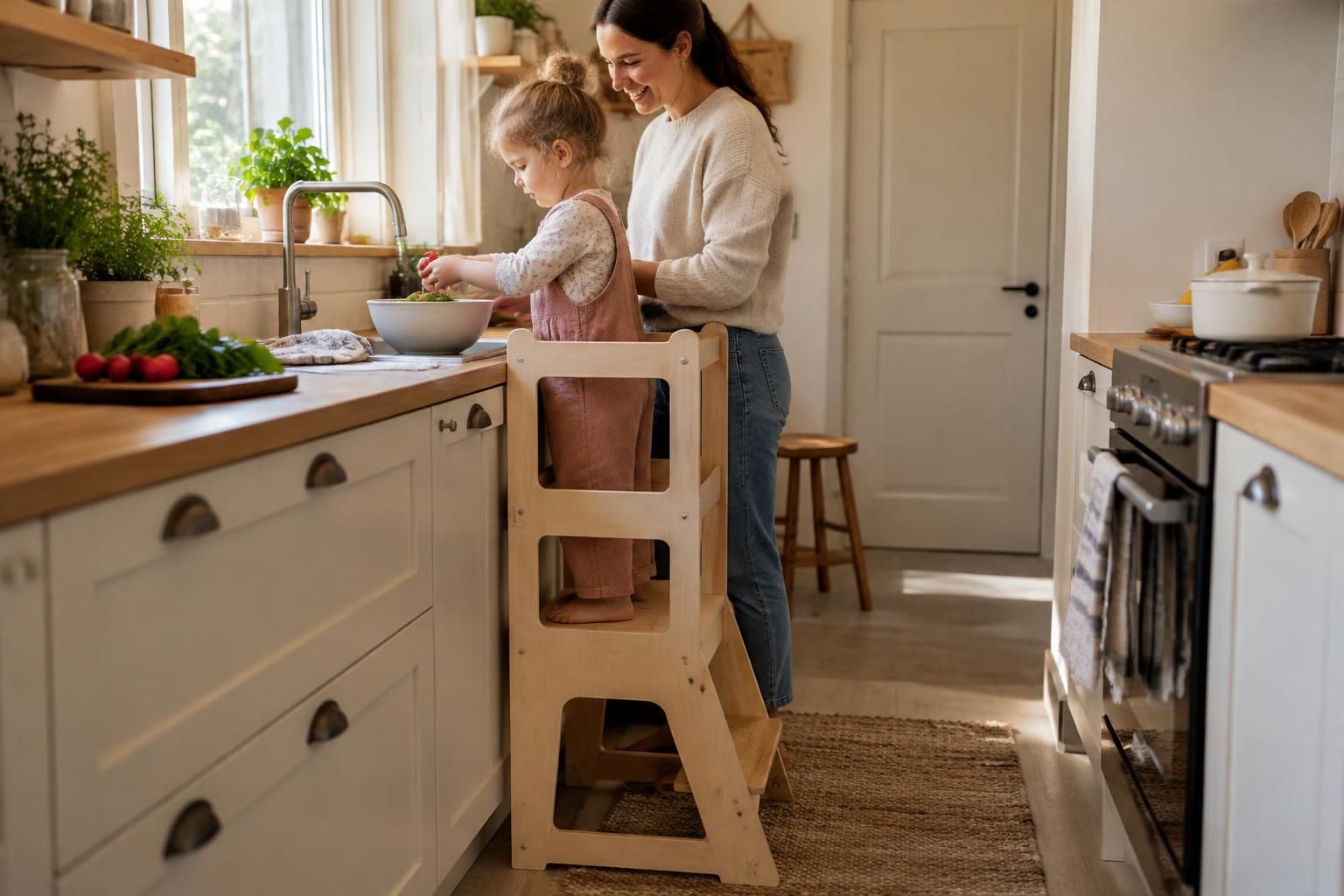
In a small kitchen, every centimeter counts and meals are often prepared with a child underfoot. A foldable Montessori tower can invite them to participate while easily being stored after the activity. But between space-saving, stability, and child safety, does this furniture really keep its promises daily? It all depends on the room’s layout, the child’s age, and some very concrete criteria.
Article summary
A foldable tower can facilitate activity in the kitchen without permanently cluttering a small space. Its usefulness mainly depends on its stability, storage, and intended use.
- The right use: Encourage autonomous learning during simple and supervised tasks.
- The real space-saving: Check the folding, weight, and where to store it.
- Priority on safety: Choose a stable structure, suitable for the child and the worktop.
- The sustainable choice: Compare materials, adjustments, and ease of maintenance before purchase.
A well-thought-out arrangement allows sharing the kitchen without turning the passage into an obstacle course.
Foldable Montessori Tower and Small Kitchen: A Truly Practical Duo?
In a narrow kitchen, every piece of equipment must justify its place. The foldable Montessori tower answers a simple desire: to allow a young child to observe and participate at adult height, then free the floor when the activity is over. For a family that cooks often, this furniture can become a small and much-appreciated observation post.
Imagine Lina, preparing a snack while her little boy washes some strawberries in a bowl. The tower gives him a defined spot near the worktop, rather than letting him pull an unstable chair or demand to be held. The benefit is not only practical: this closeness also nurtures autonomous learning, provided the adult stays nearby.
Space-saving Depends on Storage, Not Just Folding
The folding design seems ideal on paper, but you have to see what happens after the meal. A folded tower must be able to slip into a genuinely available space: behind a door, against a wall, or in a deep-enough cupboard. If it stays in the middle of the passage because it’s too heavy or bulky to move, the space-saving quickly becomes theoretical.
Before buying, it’s better to measure the intended location and check the tower’s dimensions both open and folded. It’s also useful to try the mechanism: a simple operation encourages regular storage, while a complicated folding can discourage even the most organized parents.
- Measure the passage between the worktop, table, and storage.
- Compare the tower’s width and depth when folded.
- Check whether it can stand on its own once folded.
- Evaluate its weight and ease of daily movement.
In a compact room, the best storage is the one that remains easy to use on very tired days as well as busy ones.
Child Safety: Points to Check Before Each Activity
A tower never replaces adult supervision. To limit risks, it must be placed on a flat floor, remain stable when the child climbs or turns, and be installed away from hot plates, knives, and boiling liquids. Child safety also starts with choosing an appropriate activity: washing vegetables or mixing a cold batter does not expose the same dangers as cooking.
Check the manufacturer’s instructions regarding age, maximum weight, and assembly. Locking systems must be engaged as indicated, and no folding or moving should be done with the child on it. A quick check of screws, steps, and anti-slip surfaces helps detect wear before it becomes problematic.
| Point to examine | What is preferable | Why it’s useful |
|---|---|---|
| Stability | Firm structure on flat floor, without noticeable tilting | Reduces the risk of imbalance during movements |
| Locking | Mechanism clearly locked in the open position | Prevents accidental folding during use |
| Access | Steps easy to climb and suitable platform | Allows the child to take their place without sudden moves |
| Placement | Area away from heat sources and sharp objects | Makes the activity easier to supervise |
| Maintenance | Washable surfaces and materials in good condition | Facilitates regular use in a heavily used room |
A well-chosen tower secures a participation space but does not turn the worktop into a risk-free zone: adult presence remains essential.
A Kitchen Activity That Supports Autonomous Learning
The Montessori tower makes sense when it is used for doing, not just watching. A child can rinse fruit, pour pre-measured ingredients, or mix a cold preparation. These simple gestures develop coordination and confidence, while giving them a real place in family routines.
To keep the experience pleasant, it’s better to suggest a short task adapted to their age. A cloth to wring out or some vegetables to put in a bowl often suffice. The recipe doesn’t have to be perfect: some flour on the edge of the bowl is part of learning, even if the sweeping waits until after cooking.
The tower’s presence can also create a ritual: the child knows where to position themselves and which small tasks are entrusted to them. This predictability helps share the moment without multiplying instructions, provided you remain flexible when their attention drifts to something else.
Choosing a Foldable Tower as Evolving Furniture
A useful purchase is not just about its footprint. To consider the tower as evolving furniture, you must examine height adjustments, material sturdiness, assembly quality, and ease of cleaning. A structure in good condition, designed to accompany several growth stages, can be more interesting than a very compact but impractical model.
Criteria vary depending on households. In a kitchen used by several adults, ease of moving it might be more important; in a space shared with a dining area, a tower that stores flat might be better suited. The best choice fits real habits, without promising total autonomy or replacing a parent’s supervision.
Before deciding, it’s useful to compare models based on some concrete questions:
- Is the tower stable on the kitchen floor?
- Can folding be done without particular effort?
- Do the adjustments fit the child’s current size?
- Do the materials and finishes withstand frequent cleaning?
- Is there already an identified storage location?
A clear answer to these questions helps distinguish a tempting purchase from equipment that will really find its place in family living arrangements.
Practical Questions About the Foldable Montessori Tower
From what age can a child use a Montessori tower?
The age depends on the model and the child’s abilities. You must follow the manufacturer’s guidelines and wait until the child can stand sufficiently steadily, under constant adult supervision.
Is a foldable tower suitable for all small kitchens?
Not necessarily. You need to measure the available space when open and folded, check movement around the furniture, and determine where it will be stored after use.
What can a young child do in the kitchen with a tower?
Under supervision, they can rinse fruit, mix a cold preparation, or put ingredients into a bowl. The tasks must remain appropriate for their age and away from heat sources and sharp objects.
Does a foldable Montessori tower replace a high chair?
No, it serves a different purpose: allowing the child to participate in certain activities standing up near the worktop. It does not replace equipment designed for meals nor adult supervision.


