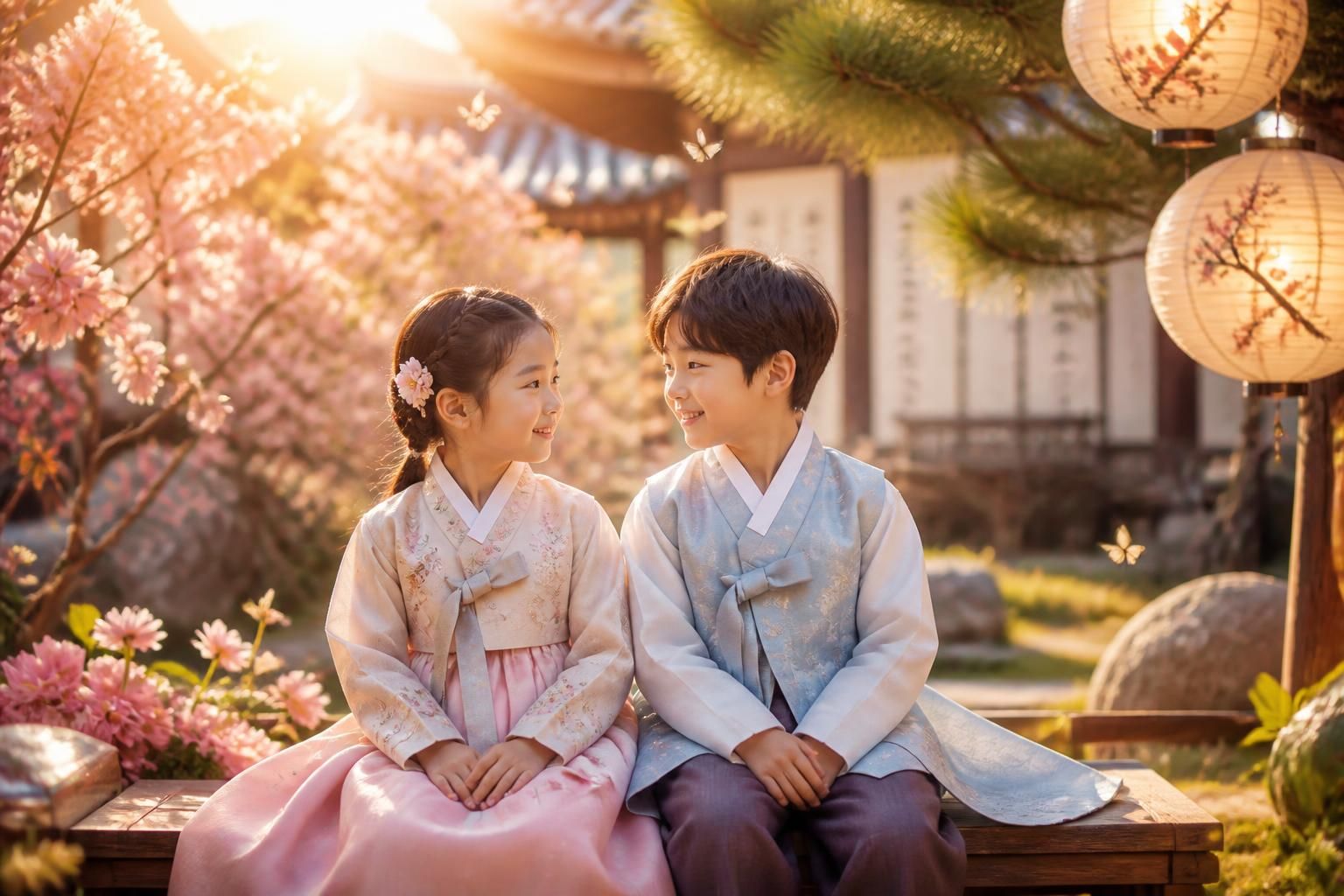
Choosing a Korean first name is often much more than a matter of sound. Between Korean culture, the Korean language, and the subtlety of hanja, each Korean name can tell a story of sweetness, strength, or light. And then, let’s be honest with each other, when a Korean girl’s first name or a Korean boy’s first name sounds good while carrying a beautiful meaning, it’s hard not to take a second look.
The article in brief
Korean first names captivate with their poetry, their values, and their multiple shades of meaning. Between Korean tradition, modernity, and name inspiration, this guide helps to spot ideas that speak both to the heart and to the ear.
- Very personal meanings: the same first name changes depending on the chosen characters
- Varied styles: classic, rare, modern, or unisex
- Useful landmarks: understanding structure, romanization, and pronunciation
- Concrete leads: tables, lists, and ideas for choosing with confidence
A practical guide to turning a name choice into a sweet and inspiring moment.
To be completely transparent, what makes a Korean first name so fascinating is this almost poetic freedom it leaves to parents. A first name can evoke wisdom, beauty, honor, luck, or courage, while remaining delicate to the ear. We quickly understand why so many families, in Korea as elsewhere, see it as a true way to pass on an intention. And if the right first name was precisely the one that looks like a little secret message for what’s to come?
In practice, Korean tradition often rests on a precise construction: the family name comes first, then the first name, generally made up of two syllables. But behind this apparent simplicity, there is immense richness, with combinations that change the meaning of a Korean girl’s first name or a Korean boy’s first name according to the characters used. That’s where all the interest is born: the same sound can carry several stories. For a name choice, this opens up a magnificent playground, at once cultural, sensitive, and very personal.
Understanding the logic of a Korean first name before choosing
Before letting oneself be seduced by a pretty sound, it is necessary to grasp how a Korean name works. In South Korea, the family name comes first, then the first name, often composed of two syllables. This difference from French usage is sometimes surprising, but it also gives a lot of rhythm and personality to the whole.
Another detail that changes everything: some surnames appear very often. Kim, Lee, Park, or Choi represent a large part of the population, which makes the first name even more important to stand out. In this context, the meaning of the first name becomes almost an intimate signature, like a little family compass.
The syllables that give meaning
A Korean first name, female or male, is often constructed from syllables derived from hanja, these Chinese-origin characters still widely used to nuance the meaning. That’s why the same writing in the Latin alphabet can hide several interpretations. It’s a bit like a well-filled notebook: everything is there, but you have to know how to read between the lines.
Parents willingly choose positive meanings, linked to wisdom, kindness, success, or light. Result: the first name doesn’t just sound nice, it also carries a promise. And in Korean culture, this symbolic dimension matters a lot.
Korean first names for girls between sweetness, nature, and character
When it comes to a Korean girl’s first name, the trend often leans towards soft sounds, images of flowers, sky, light, or water. It’s no accident: musicality counts as much as meaning. Many families love this mix between tenderness and discreet strength, very present in the Korean language.
To illustrate this, let’s imagine Hana, a future little girl whose parents want a first name that crosses time without losing its freshness. They hesitate between a poetic value and a more modern breath. This is exactly where Korean first names shine: they leave room for elegant, sincere, sometimes very rare choices.
| First Name | Associated Idea | Shade of Meaning |
|---|---|---|
| Ha-eun | Sweetness and multiple nuances | Kindness, goodness, greatness depending on the characters |
| Ji-a | Bright and refined first name | Wisdom, beauty, grace |
| Seo-yun | Current and elegant choice | Luck, sweetness, finesse |
| Nari | Accessible floral reference | Lily, natural delicacy |
| Haneul | Broad and soothing image | Sky, paradise, freedom |
This table clearly shows how much name inspiration can come from a simple detail: a flower, a sensation, an idea of light. And for those who like more singular first names, Bora, Eun-Kyung, or Ae-Cha bring a rarer color without losing their charm. Underneath it all, the true secret remains the same: finding a first name that makes the heart beat a little faster.
When modernity meets Korean tradition
Popular first names like Seo-Yeon, Ji-Woo, or Ha-Yun clearly show the evolution of tastes in Korea. They remain anchored in Korean tradition while having a very current look. These are often easy-to-wear first names, even outside Korea, which explains their success with mixed families or parents sensitive to elegant sobriety.
If the need is to find a more original Korean girl’s first name, options like Bora, Choon-Hee, or Myung-Ok bring a different relief. These choices appeal to those who like to step off the beaten path without going towards something extravagant. Frankly, it’s often there that the most beautiful crushes are born.
To go further with feminine ideas full of style, a detour by these ideas for original girl’s first names can also open other complementary avenues. The best part, in this kind of research, is that one first name often leads to another.
Korean first names for boys, between strength, wisdom, and light
On the side of a Korean boy’s first name, the sounds often become more marked, with an impression of solidity, momentum, or success. The syllables can evoke stone, courage, sun, merit, or honor. It’s never aggressive; it’s rather a calm strength, very beautiful to carry.
In a family looking for a first name that is both modern and symbolic, names like Seo-Jun, Ji-Hoon, Ha-Joon, or Eun-Woo have that little reassuring something. They sound good, are clearly written, and keep real depth. The kind of combination that avoids trends that date too quickly.
| First Name | Evoked Image | Associated Value |
|---|---|---|
| Seo-Jun | Much-appreciated balance | Talent, good omen |
| Ji-Hoon | Solid classic | Wisdom, merit |
| Ha-Joon | Current sound | Greatness, talent |
| Yong | Short and strong first name | Dragon, bravery |
| Hwan | Bright and luminous glow | Brilliant, shining |
This logic also inspires unisex first names, increasingly appreciated in contemporary choices. Jimin, Haneul, or Si-woo cross genders without losing their personality. And it’s very practical when you want a Korean name that keeps style without too much confinement.
Unisex first names, perfect for freer inspiration
In Korea, some first names work for girls as well as boys. This flexibility is increasingly liked because it leaves room for an open and modern interpretation. For a couple who wants to move away from overly rigid categories, this is a very interesting path.
Haneul, for example, evokes the sky and carries universal sweetness. Jimin, on the other hand, remains known in several cultural universes, which makes it a very accessible reference. If the first name choice is made together, with sometimes different tastes, these unisex names often bring a real meeting ground.
And then, let’s be honest, a first name that pleases everyone is already a little family victory.
Romanization, pronunciation, and little traps to know
Romanization is not always uniform, and that’s normal. The same first name can appear in several Latin forms according to conventions or usage. This reality often surprises parents who discover the richness of the Korean language, but it should not slow down momentum.
For more comfort, it’s better to keep the general idea rather than cling to a single spelling. Kim is close to “guim,” Park to “bak,” Lee is said rather “i,” and Choi sounds like “tchoué.” No need to be perfect from the start: the important thing remains the intention and respect for the name.
Some useful landmarks before deciding
- Check the exact meaning: the same syllable can change depending on chosen hanja
- Listen to the sound: a first name must remain fluid when spoken
- Think about daily use: in France and elsewhere, simplicity helps
- Compare multiple spellings: romanization can vary slightly
- Keep the symbol in mind: the first name must convey a clear intention
These landmarks prevent getting lost in the details and help to keep on track. For a serene first name choice, it’s better to move forward methodically, but without tensing up. Deep down, the right Korean name is the one that resonates just right, for a long time, effortlessly.
How to find a Korean first name that really resembles you
The simplest is often to start from what one wants to transmit. Sweetness, strength, luck, wisdom, nature, or light already give a very clear direction. Then, it’s enough to compare a few first names, say them out loud, and see which ones stay in mind.
At this stage, a fictional family like Mina and Julien might hesitate between Ji-a, Haneul, and Seo-yun. Their criterion? A first name that travels well, that keeps meaning, and that doesn’t lose its poetry in daily life. This kind of decision is a bit like a walk by the water: we move forward, go back, then suddenly the obvious right choice imposes itself.
For those who like to cross inspirations, another look at the culture and meaning of Korean first names can help refine the selection. And if the desire leans towards a more discreet homage, even a project like a forearm first name tattoo can show how much a first name can carry a strong emotional charge.
Ideas according to the emotion you want to convey
When the priority is sweetness, Nari, Soo-ah, or Mi-So work wonderfully. For a stronger impression, Yong, Hwan, or Gi give a different relief. And for a more poetic touch, Haneul, Bora, or Ji-woo offer a very attractive balance between modernity and symbolism.
The most interesting thing is that this choice is never limited to a trend. A Korean first name can become an intimate landmark, a way to tell a birth, a story, or a hope. That’s where the emotional dimension meets the beauty of the word.
How to know if a Korean first name is suitable for a little girl or a little boy
Many Korean first names are unisex, but some sounds and meanings are more often associated with a Korean girl’s first name or a Korean boy’s first name. The most reliable thing remains to check the meaning of the first name and common usage.
Why can the same Korean first name have multiple meanings
Because in Korean culture, the meaning often depends on the hanja chosen for each syllable. The pronunciation can remain identical, but the symbolic scope changes according to the characters.
Are Korean first names easy to wear in France
Yes, many are, especially short or fluid forms like Ji-a, Soo-ah, Haneul, Ji-woo, or Seo-yun. The best is to choose a first name that remains simple to say and pleasant to the ear.
Can we get inspiration from K-pop to choose a first name
Yes, of course, especially if you like modern and international first names. Jisoo, Jimin, or Haneul are popular examples that blend name inspiration and contemporary Korean culture.
How to avoid mistakes in pronunciation
It is better to listen to the first name out loud, compare several romanizations, and retain the sound rather than a unique spelling. In case of doubt, the simplest version often remains the most comfortable daily.