

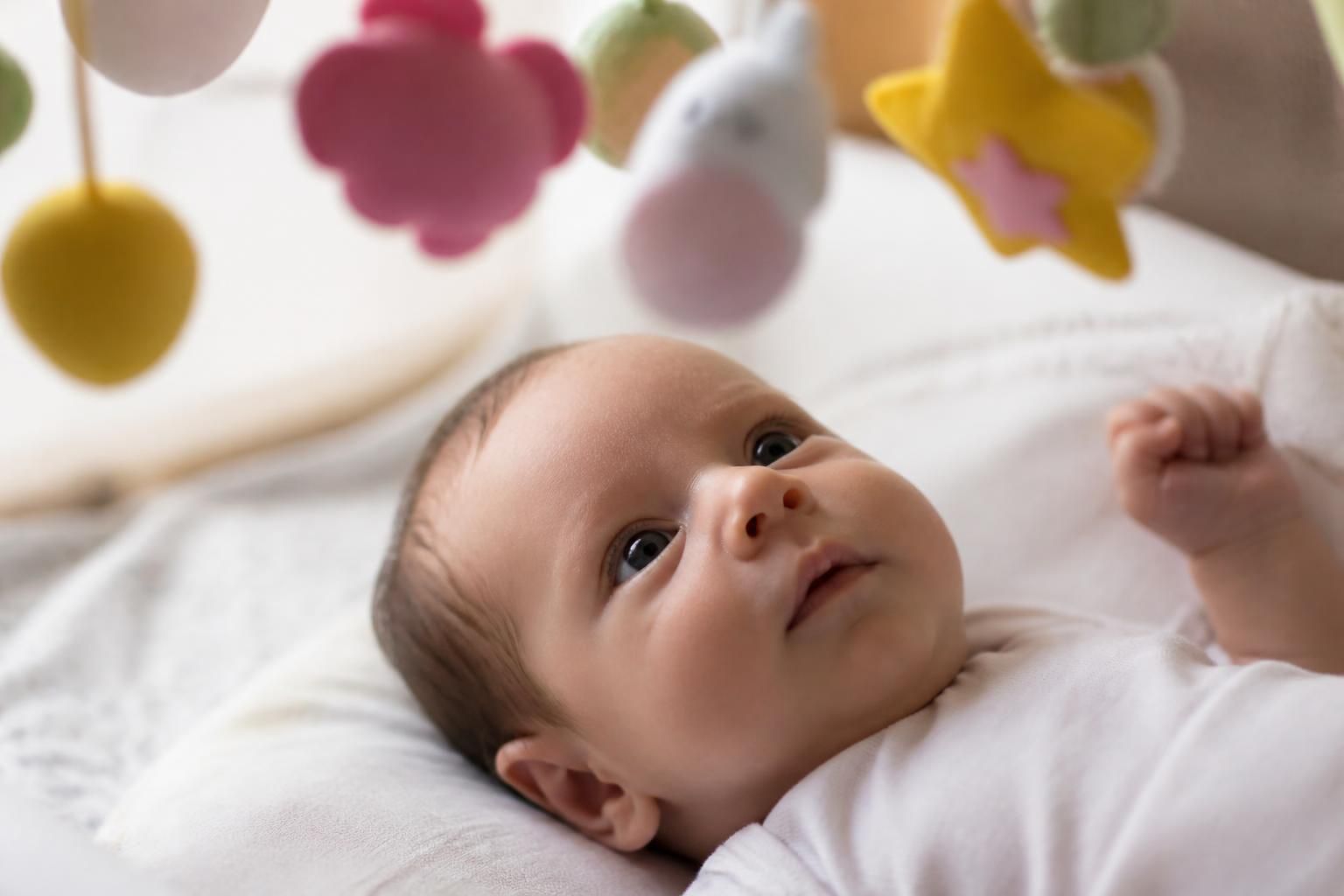
Watching the gaze of a toddler is witnessing a remarkable sensory adventure. From birth, baby’s vision is imperfect, almost blurry, but full of promise. At only one month old, this perception slowly sharpens, with a visual system learning to decode shapes, gradually distinguishing contours, and beginning to open up to colors. From limited visual acuity to the first visual stimuli, understanding this development helps to better support the baby’s discoveries and daily interactions.
The article in brief
Dive into the fascinating world of vision in a one-month-old baby and discover how their visual abilities evolve from birth.
- Blurred vision at birth : baby primarily perceives shapes and strong contrasts at close distance.
- Rapid progression : improvement of acuity and visual tracking during the first weeks.
- Color perception : begins around 3 months with a preference for red and green.
- Appropriate stimulations : high-contrast toys and facial interactions enhance ocular growth.
Understanding this visual evolution is a key to supporting baby’s very first looks at the world.
How does baby’s vision evolve during the first month?
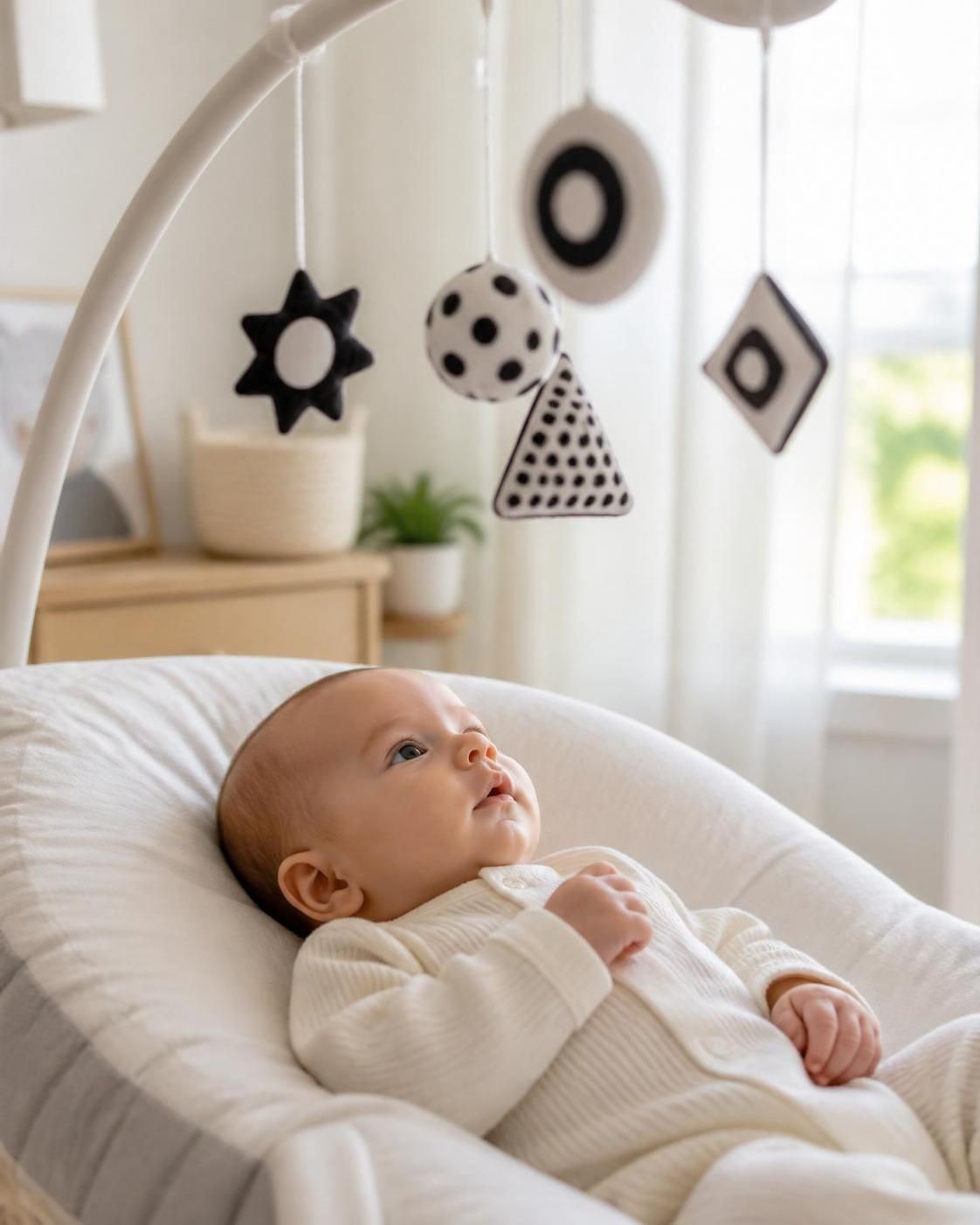
At birth, baby’s vision is far from perfect. Their visual acuity is low, around 1/20th, comparable to the ability to read the largest letter on an adult eye test. This limitation is explained by the still incomplete maturation of the cells responsible for vision, notably the retinal cones, which manage details and color. Baby mainly perceives nearby objects, at a distance of 20 to 30 centimeters, which is perfect for distinguishing the faces of their parents during cuddly moments. Strong contrasts, like black and white, especially attract their gaze as they stimulate their still-developing system more strongly.
During this first month, ocular growth is accompanied by a gradual improvement in eye-hand coordination. Although vision is still blurry and limited in colors, baby begins to track moving objects, a crucial step towards finer perception.
Why can bright light bother baby ?
It is often noticed that newborns squint at bright light. This sensitivity is explained by the fragility of their immature visual system which naturally protects the retina. Thus, baby generally prefers environments with dim or indirect light, which helps to avoid any discomfort and promotes better visual comfort. That is why parents are encouraged to limit direct exposure to intense light, favoring soft and natural atmospheres during the first months.
The evolution of color perception in the infant
At first, a one-month-old baby’s vision does not distinguish colors: only a black and white world fills their visual field. The ability to perceive colors begins, however, to develop progressively around three months. It is then that baby glimpses fundamental hues like red and green, and by six months, they integrate blue and yellow. Full color perception and fine shades are generally acquired only between 18 and 24 months.
To encourage this stage, offering toys with bright and contrasting colors is ideal. Recognized brands like Chicco or Béaba design suitable objects, highly appreciated for their ability to capture infants’ attention while stimulating their sensory development.
What games to stimulate baby’s vision?
- High-contrast mobiles : hung above the crib to promote gaze fixation.
- Colorful objects : bright shapes and colors to enrich visual perception.
- Mirror play : encouraging self-recognition through a safe mirror.
- Musical toys : combined with gentle visual animations, combining the senses.
These simple activities stimulate not only eye tracking ability but also strengthen the emotional bond through direct interaction between parents and child. This stimulation is a key to supporting the establishment of visual abilities.
Binocular vision and the first signs to watch for
The development of binocular vision, which allows both eyes to work together to provide depth perception, begins after the first months. In one-month-old infants, it is not uncommon to see desynchronized eye movements or slight intermittent strabismus. These phenomena are generally temporary and reflect the natural sensory maturation process.
However, if signs of strabismus persist beyond three to four months, or if other concerning symptoms appear, it is recommended to consult a specialized ophthalmologist. Early detection of visual disorders such as strabismus, amblyopia, or other anomalies facilitates referral to appropriate and preventive treatments.
Symptoms requiring specialized consultation
- Refusal to follow a moving object.
- Permanent strabismus beyond four months.
- Excessive sensitivity to light and tearing.
- Frequent blinking or constant eye rubbing.
- White pupil visible in photos.
Contributions of neuroscience to understanding vision
Neuroscience research has confirmed that from the fifth month of pregnancy, the connections between the eyes and the visual cortex begin to form. This network continues to refine throughout the first year, especially under the effect of received visual stimuli.
The more varied and adapted the visual stimulation, the better baby’s memorization and learning abilities improve. The quality of parent-child interactions, where the gaze plays a major role, thus promotes harmonious development of the visual and cognitive system. In this context, choosing eco-friendly French toys to nurture the senses is no coincidence; it is a gesture that pays tribute to authenticity and respect for childhood.
Summary table of visual progression during the first year
| Age | Visual abilities | Recommended stimuli and games |
|---|---|---|
| Birth to 1 month | Blurred vision, low acuity, light sensitivity | Contrast mobiles, close faces, and facial expressions |
| 3 months | Perception of red and green colors, beginning of eye-hand coordination | Colorful toys, mirror play, intense visual interactions |
| 6 months | Binocular vision, improvement in color perception | Textured objects, toys combining sounds and images |
| 12 months | Improved acuity, recognition of familiar faces and images | Suitable educational toys, simple picture books |
The evolution of baby’s vision month after month is a delicate dance between biological maturation and respectful stimulation. By understanding this progression, every parent can offer a world rich in sensory discoveries, healthily stimulating their child’s visual and emotional capacities.
To enrich the family experience, it is even interesting to complement this support with appropriate readings. References on best practices to choose interactive children’s books enrich early exchanges and bring the story of the gaze to life from the cradle.
Finally, managing the play space and baby’s objects optimally greatly facilitates their visual exploration. An organization thoughtfully designed, inspired by tips to store toys efficiently, contributes to a serene and stimulating environment.
When does baby really start to distinguish faces?
Baby distinguishes contours and nearby faces from birth, but it is from 1 month that they begin to better fixate and follow facial expressions.
How to encourage visual development in an infant?
Increasing visual interactions, offering toys adapted in bright colors and strong contrasts, and avoiding overly bright lights promote ocular growth.
What signs indicate a vision problem to watch for?
Persistent strabismus, excessive light sensitivity, or refusal to follow a moving object are signals not to be neglected and require consultation.
Why is baby’s vision so blurry at the beginning?
Visual cells, notably the retinal cones, are still maturing; that is why baby primarily perceives shapes and contrasts without precise details at first.


