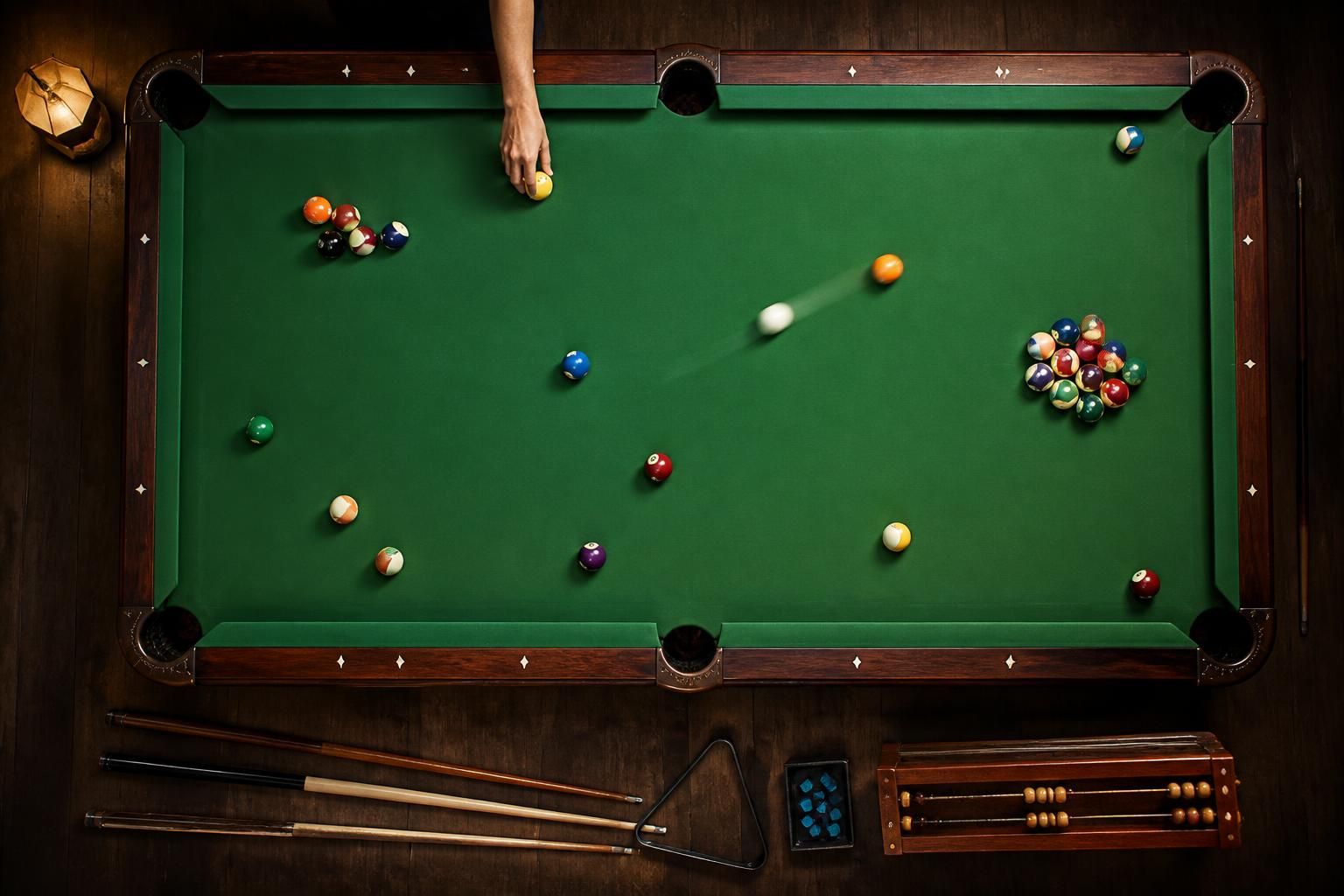
Around a pool table, everything seems simple at first glance. Yet, between the placement of the billiard balls, the break, fouls in billiards, and the famous black ball that decides a game, American pool quickly holds some traps. Good news: once the rules of billiards are understood, the game becomes much smoother, more strategic, and frankly more enjoyable to play among friends or in a hall.
The article in brief
American pool, especially in the 8-ball version, is based on a simple but precise logic: break correctly, choose your group, avoid fouls, and pocket the 8 at the right moment. Variations of American pool add rhythm, but the basics remain the same.
- The goal of 8-ball: pocket your group then finish with the black ball
- The break and triangle: respect the placement and opening of the game
- Decisive fouls: ball in hand, wrong ball hit, ball off the table
- Variations to know: 8-ball, 9-ball, and 14.1 depending on the vibe
By mastering these markers, the billiard table ceases to be a blurry field and becomes a true billiard strategy terrain.
In many bars, the game starts lightly, then questions come quickly: who plays solids, who takes stripes, and especially, when can the black ball be attempted without losing everything? It is often here that the charm of American pool operates. Behind its late-night entertainment appearance, it hides a precise framework, with allowed moves, penalized fouls, and variations of American pool that completely change the pace.
To be completely transparent, it is exactly this precision that makes the interest of 8-ball pool. A good reading of the table, a clever shot choice, and some well-placed pool techniques can turn a hesitant game into a clean sequence. And then, let’s be honest among ourselves, nothing is more frustrating than a black ball pocketed too early after a nice run… the famous moment when the smile freezes a second too late.
Rules of American pool: understanding the principle of the billiard game
American pool is played on a pool table with six pockets, fifteen numbered balls, and a cue ball. The most common format in France remains 8-ball: one player must pocket the solid balls, the other the stripes, then finish on the 8. It is usually played by two, sometimes in doubles, for quick games generally lasting between 10 and 25 minutes.
What makes the difference is the clarity of the framework. Each shot must make sense, because the rules of pool require hitting the correct ball first, then producing a valid action: ball pocketed or contact with a cushion depending on the case. This logic avoids random play and gives every shot a real tactical value.
Essential equipment for proper play
A classic set includes the cue ball, fifteen numbered balls, a triangle, a cue stick, chalk, and a 7- or 8-foot table. On the field, one detail sometimes changes a whole game: a worn cloth, slightly stiff cushions, or a marked ball can alter trajectories. That is exactly why a successful game often starts with a quick glance at the equipment.
In a club or a bar, it is also better to check the stability of the pool table and the condition of the billiard balls. A well-maintained table makes rebounds more predictable, thus shots more accurate. And along the way, this avoids those famous exchanged looks when a ball jumps unexpectedly.
| Element | Role in the game | Point of attention |
|---|---|---|
| Cue ball | Ball struck on each shot | Never intentionally pocket it |
| Numbered balls | Define groups and victory | Clearly distinguish solids and stripes |
| Triangle | Organizes the start of the game | The 8 must stay in the center |
| Chalk | Improves tip grip | Essential for spin shots |
Setting up the 8-ball and starting the game
The setup follows a simple logic: the fifteen balls are tightly packed in a triangle, with the 8 in the center, the 1 ball at the apex, and one solid and one stripe in the two back corners. The cue ball starts behind the head string, ready for the break. This placement is no accident: it ensures balanced dispersion and avoids overly chaotic game starts.
At the break, the player must send the cue ball toward the triangle regularly. According to reference rules, a break is valid if at least one ball is pocketed or if several balls hit a cushion after impact. Otherwise, the opponent can request a replay or take the table as it is.
When the break assigns the groups
After the break, the table often remains open until a player legally pockets a ball. At that moment, they receive their group: solids from 1 to 7 or stripes from 9 to 15. The other player automatically gets the other side. This small moment decides a lot, as it sets the line of conduct for the rest of the game.
Sometimes, no ball goes in on the first legal shot. In this case, no one owns a group yet and anyone can aim freely. This opening moment often leads to very tactical games, where a simple strategic shot prepares the next plays better than a spectacular shot.
Fouls in billiards: those that change everything in the game
Fouls in billiards are the real backbone of the game. The most known one is pocketing the cue ball: the opponent then gets the ball in hand, often anywhere on the table in modern amateur play, sometimes behind the head string according to some break rules. Other errors are just as penalizing: wrong ball hit first, no valid contact after impact, ball sent off the table, or unintentional double hit.
The key point is simple: a foul doesn’t just lose the turn, it grants a concrete advantage to the other player. And in a tight billiard game, this lead can be enough to flip the match in a single visit. That’s why regular players talk as much about pool strategy as about pure precision.
- Cue ball pocketed: opponent gets ball in hand
- Wrong ball hit: foul if the table is closed
- No cushion contact: foul under strict rules
- Ball off the table: repositioning or penalty depending on the case
- Pushed or double hit: forbidden move, point lost
Ball in hand, or the chance to restart strong
Receiving the ball in hand changes everything. The penalized player often leaves an open table, and the other can place the ball in a very favorable zone to build a run. It is the kind of moment when pool techniques become visible: angle of approach, draw shot, safety play, reading the cushions.
In bars, this rule is often decisive because it shortens turnarounds. A badly punished foul can give the ideal starting point to clear the rest of one’s group. Like in a good card game, positioning sometimes counts as much as the shot.
Pocketing the 8: the rule that decides the match
The black ball is played only at the very end, once all the balls of the group are pocketed. Under the strictest rules, the pocket must even be called before the shot. If the 8 falls at the wrong moment, or in wrong conditions, the game is lost immediately.
This endgame requires composure. A table may seem perfectly controlled, then flip on a simple overconfidence. That’s why good players always keep a safety margin before the last shot, even choosing a less brilliant but much safer position.
What causes immediate loss
Several errors lead to immediate defeat: pocketing the 8 before finishing one’s group, sending the black ball off the table, or pocketing the 8 simultaneously with a foul. If the cue ball also ends in a pocket, the penalty is the same in the standard format. The idea is simple: the last ball must be controlled, not just attempted.
In friendly games, a bit more leniency may be allowed on calling the pocket. But whenever there is a stake, precision becomes queen again. It is often here that the tension is most delicious.
American pool variations: 8-ball, 9-ball, and 14.1
8-ball pool remains the most popular version for leisure, especially indoors and in bars. 9-ball, on the other hand, is faster: you must hit the lowest numbered ball first, then seek the 9 to win. 14.1 continuous, also called straight pool, demands more anticipation and call shots, with a more tactical and less immediate dimension.
These American pool variations do not just change the rhythm. They modify the way of thinking about positioning, risk-taking, and run construction. For a curious player, switching from one to another is a bit like changing the tempo in music: the notes remain close, but the energy is no longer the same.
| Variation | Principle | Playing atmosphere |
|---|---|---|
| 8-ball | Finish your group then the 8 | Ideal for leisure and bars |
| 9-ball | Hit the lowest ball first, win on the 9 | Faster, more dynamic |
| 14.1 continuous | Chain points with series logic | More technical and demanding |
A typical game to understand the flow
Let’s take a simple example. After a proper break, a player pockets a solid ball and takes that group, then strings together two more clean shots. He then misses his target, handing the turn to the opponent. The latter exploits the position, advances his stripes, then leaves the table ready for a clean finish on the 8.
This scenario clearly shows the balance of the game: a single slip is enough to change table control. In a lively hall, with background noise and others’ looks, this shift becomes even more visible. It is this mix of calm and tension that makes American pool so gripping.
Etiquette, pace in bars, and table maintenance
Beyond the rules, pool has its tacit language. In a public hall, players respect turn order, call ambiguous shots, and avoid touching the table when the opponent is aiming. These details matter almost as much as the score, as they guarantee a smooth and pleasant game for everyone.
A minimum of maintenance also helps enormously. A brushed table, clean balls, and a well-chalked tip improve shot quality. And when conditions are clean, pool strategy becomes clearer without having to compensate for unpredictable rebounds.
In practice, players often progress faster when they know a few simple markers. For example, calling “middle of 7” or “draw shot” avoids many misunderstandings, especially in a noisy bar. This small clarity effort often gains smoothness that would otherwise be lost in discussion.
For further learning, a complementary guide may be useful, such as the one available here: American pool rules explained simply. And to compare the 8-ball approach with another perspective on the game, this detour to the practical American pool rules helps establish the basics without getting lost in technical terms.
What is the difference between 8-ball and 9-ball?
8-ball requires finishing your group before the black, whereas 9-ball requires playing balls in numerical order and winning on the 9. 8-ball is more common for leisure, 9-ball is faster and more direct.
What happens if the cue ball and the 8 fall together?
In standard American pool rules, it is an immediate loss for the player on turn. The black ball must be played cleanly, without associated fouls.
Must the pocket be called for the black ball?
In strict competition, yes: the pocket for the 8 must be called. In bar games, the practice is often more relaxed, but it depends on local habits.
Can the opponent’s ball remain pocketed?
Yes, if the shot is otherwise legal. The player gains nothing by pocketing an opponent’s ball, but it does not return to the table.
Why can a break be rejected?
If the break is not active enough, for example without pocketed balls or correct cushion contact, the opponent can request a replay or accept the table depending on the applied framework.