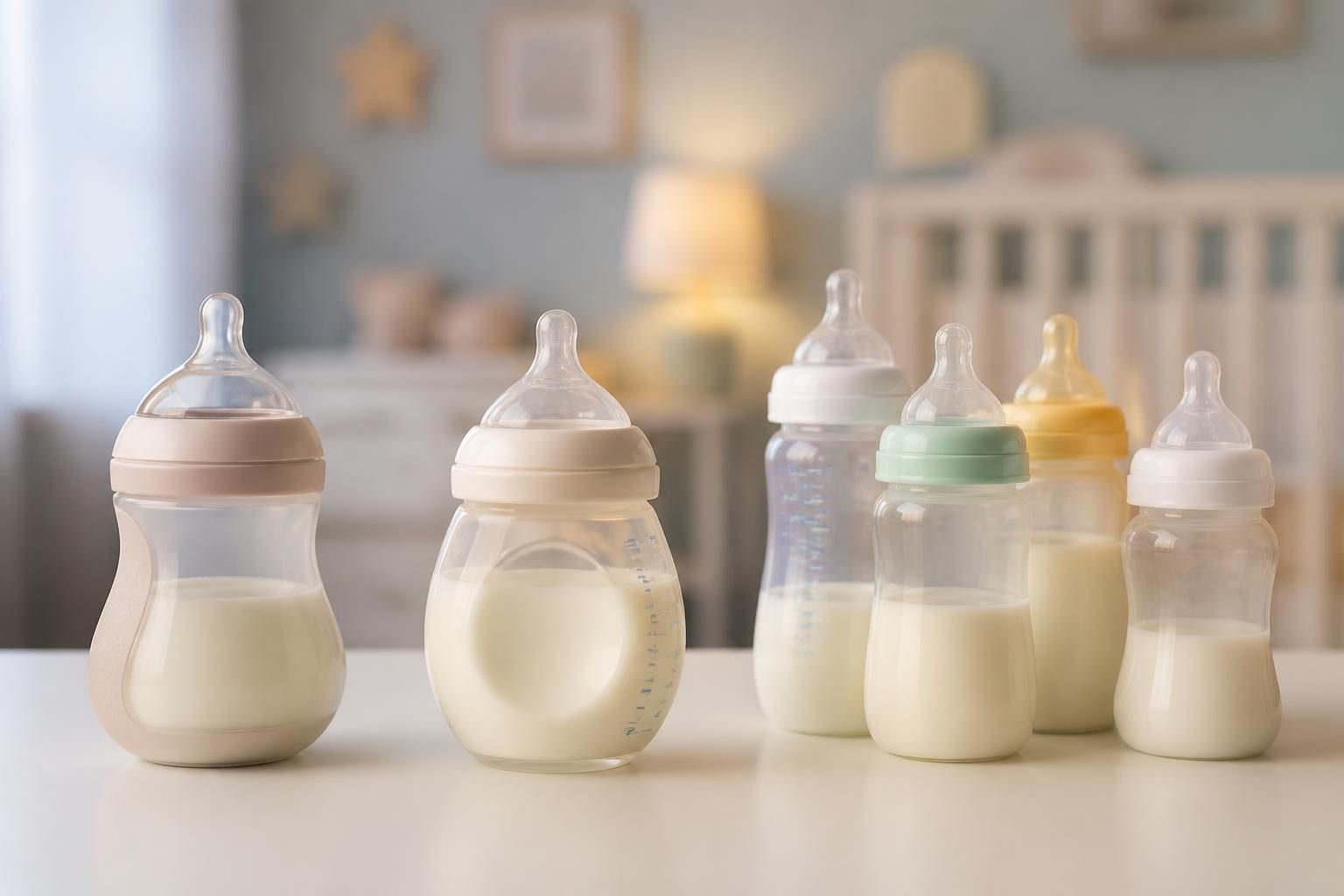
When the breast remains the main reference but a bottle becomes part of everyday life, everything becomes a matter of precision. Between mixed feeding, expressed breastmilk, and popular models, the right bottle choice mainly depends on the nipple, flow rate, and the way milk is given. The idea is not to disrupt baby’s feeding but to preserve breastfeeding compatibility while maintaining a manageable organization for the whole family. Let’s be honest with each other: when fatigue sets in, a well-thought-out detail can change the entire day.
The article in brief
The right bottle does not replace the breast; it accompanies it delicately. By choosing a suitable nipple and a flexible pace, mixed breastfeeding often becomes much smoother.
- Preserve the breast-bottle balance: Focus on a rhythm respectful of the infant
- Choose a reassuring nipple: Prefer a slow flow and a soft shape
- Support lactation without pressure: Keep key feedings and observe baby
- Compare uses according to the family: Adapt the model to everyday reality
Well chosen, a bottle can really facilitate mixed breastfeeding without breaking baby’s landmarks.
In real life, mixed feeding rarely appears as a big, perfectly planned project. It rather happens over weeks, when returning to work approaches, when a night has been too short, or when a backup becomes necessary to catch a breath. To be completely transparent, it’s not a confession of failure; it’s often an intelligent adaptation, a bit like reorganizing a room to move around without stubbing your toes everywhere.
The sensitive point remains the same: how to maintain good breastfeeding compatibility between breast and bottle? Families who manage best rely on a coherent whole: a soft nipple, slow flow, a mouth grip that recalls the natural gesture, and a tempo that respects baby’s signals. It’s this kind of discreet detail that makes all the difference on a daily basis.
Choosing a mixed feeding bottle without disrupting the balance
The bottle choice is not just about design or brand. You have to look at the material, the neck, the flexibility of the nipple, and especially the flow rate, because milk does not behave at all like on the breast. Where suction must be active, the bottle can, if badly chosen, deliver milk too quickly and confuse baby’s cues.
A good model therefore tries to reproduce a sensation close to nursing, without trying to copy it perfectly. It’s a bit like choosing soft shoes for a first step: they don’t walk for the child but help them keep their balance.
The right time to introduce the first bottle
The most often recommended time is around four to six weeks, when lactation is well established. Before this milestone, replacing feedings too early with bottle feedings can slow production, especially if the breast is no longer regularly stimulated.
In a family juggling schedules, the idea is often to introduce the bottle during an occasional feeding, at a quiet time. A relaxed infant, neither too hungry nor too tired, generally accepts this novelty better than in the middle of great frustration. And let’s be honest, no one likes learning something new in the middle of stress.
Popular models: what really matters
Popular models often share a common point: they feature a physiological nipple, slow flow, and a comfortable mouth grip. Glass, PPSU, silicone, or lightweight plastic can be suitable, but the material never compensates for an ill-fitting nipple. This is where many parents get trapped by marketing.
Within a family, the right model is not necessarily the one that gets the most attention. It’s the one that cleans easily, travels leak-free, and doesn’t require reinventing everything at every meal.
| Format | Main asset | To watch out for | Ideal use |
|---|---|---|---|
| Bottle with physiological nipple | More natural mouth grip | Flow rate to check carefully | Start of mixed feeding |
| Wide-neck bottle | Quick and practical cleaning | Not all wide nipples are equal | Regular home use |
| Glass bottle | Durable and neutral material | Heavier weight | Calm meals at home |
| PPSU or silicone bottle | Light and easy to slip into bag | Nipple quality to control | Outings, backup, and travel |
Breastfeeding and bottle: preserving compatibility without stress
The big question, at heart, is not about choosing between two camps. It’s rather about finding a balance that protects breastfeeding while making daily life more flexible. When the breast remains central to the day, the bottle can become a very precious ally, provided baby’s signals are respected and some strategic feedings are kept.
Morning and evening are often the most favorable times to maintain stimulation. During the day, a backup can be entrusted to the co-parent, provided a rhythm is kept that does not turn the meal into an automatic routine. A well-thought-out small organization often beats a big plan that’s impossible to maintain.
For families wanting to keep it simple, some resources help clarify things, such as this guide on the balance of mixed breastfeeding or the concrete landmarks around the distribution of feedings and bottles. When the framework is clear, everything becomes a little less exhausting.
The feeding rhythm that really helps baby
The way milk is given matters almost as much as the container. A semi-upright position, regular pauses, and a bottle presented without rush help avoid the continuous flow that sometimes disorients babies used to the breast.
The real reference is not to empty the bottle at all costs. It’s about observing satiety, relaxed lips, and calm returning. Baby’s feeding thus becomes an exchange, not a race against time.
- Position: baby semi-upright, well supported, without forcing the latch
- Flow: slow at the start, to respect suction
- Pauses: let baby breathe and recover between sips
- Observation: stop before completely empty if satiety is reached
- Flexibility: adjust according to mood and time of day
This steady rhythm works particularly well when the family goes through a busy period. It’s also what helps preserve infant nutrition without disrupting the relationship around feeding. A discreet bottle, well used, knows how to fade away where needed.
Which milk to choose with a bottle during breastfeeding
When expressed breastmilk is not enough to cover all feedings, infant formula takes over. Before diversification, breastmilk remains the reference closest to baby’s daily life, but first-stage formula is the classic benchmark when a supplement becomes necessary. Later, second-stage formula accompanies evolving needs.
In case of digestive sensitivity, allergic history, or medical advice, the choice is made with a healthcare professional. Here, it’s better to avoid improvisations: infant nutrition is never just a matter of a nicely printed label.
| Stage | Milk generally used | Practical benchmark | Point of vigilance |
|---|---|---|---|
| Birth to 4-6 months | First-stage formula | Before diversification | Adjustment with medical follow-up |
| After diversification | Second-stage formula | When solids come into play | Adapt to growth |
| Particular situation | Specific formula | Allergy, intolerance, or medical advice | Do not change alone |
If baby rejects a new taste, nothing abnormal. The palate changes, breastmilk already varies day to day, and adaptation may require some trials. In these moments, it’s better to proceed in small steps than to turn the meal into an arm wrestling match.
For parents returning to work, an adjusted rhythm can also be useful at home, as shown by advice on returning to work after baby. And when preparing for a longer outing, a well-packed bag often saves a lot of time, as in this guide on organizing the diaper bag.
Spotting mixed feeding that works well daily
A mixed feeding that works is read in simple signs: baby sucks without turning away permanently from the breast, diapers are well wet, weight follows its curve, and meals remain generally calm. The parent’s comfort also matters, because repeated engorgements or persistent pain indicate an adjustment is necessary.
The most reassuring is often the regularity of little things. A family keeping a flexible rhythm, without rigidity, usually ends up finding its pace. The famous moment when twins synchronize… but for causing mischief, parents know, and it also applies to meals: everything never goes perfectly, but everything can stay harmonious.
To support this phase without feeling overwhelmed, it can be useful to rely on concrete resources like this guide on bottle feeding for breastfed newborns or on gentle weaning support. These landmarks allow moving forward without guilt, and it’s often where everything calms down.
Bottle feeding: useful reflexes before starting
Before buying, it’s better to check a few simple points. A nipple that flows too fast, an impractical material, or a format difficult to clean can quickly complicate meals. Conversely, a simple and coherent model with baby’s habits becomes a true daily support.
Here are the most useful criteria to keep in mind:
- Slow flow to preserve suction and satiety
- Soft nipple for a more natural latch
- Practical format depending on home, outings, or backup
- Easy cleaning to avoid unnecessary mental load
- Breastfeeding compatibility to keep the breast in its rightful place
A well-chosen bottle does not do everything, but it can really lighten the day. And in an already full family life, that’s far from a detail.
Which bottle to choose to start mixed breastfeeding?
A bottle with a soft nipple and slow flow is often the best adapted to preserve baby’s landmarks and breastfeeding compatibility.
When to introduce the first bottle during breastfeeding?
When lactation is well established, often around four to six weeks, unless medical advice or special need.
Can the bottle interfere with breastfeeding?
Yes, especially if the flow is too fast or if the breast is less stimulated. Thoughtful use limits this risk.
Which milk to give if expressed breastmilk is not enough?
Before diversification, first-stage formula is generally used. Then, second-stage formula takes over, with medical advice if necessary.
How to know if mixed breastfeeding goes well?
Baby remains comfortable at the breast and bottle, diapers are well wet, growth follows, and meals stay calm.