

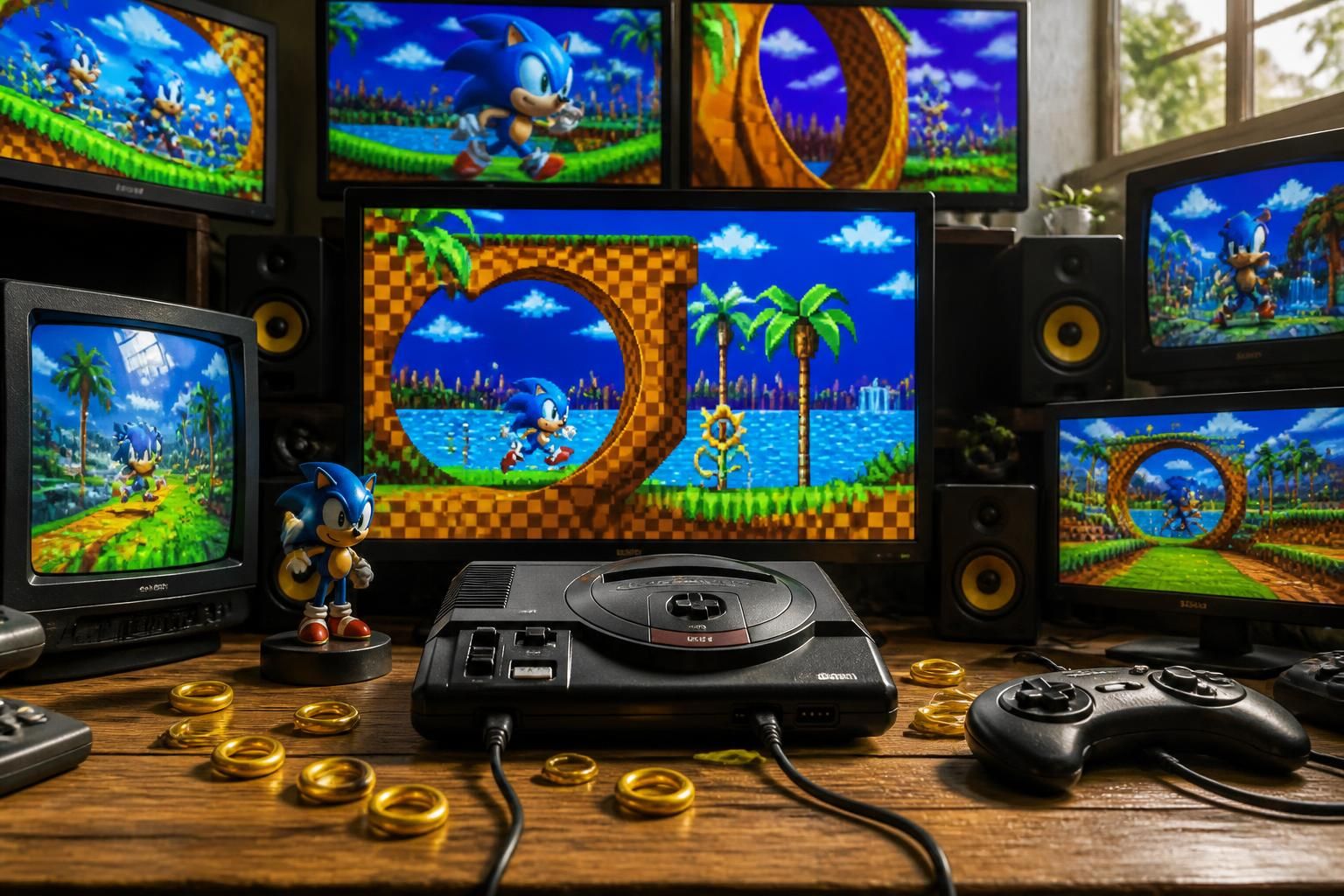
There are consoles that you tuck away at the back of a cabinet, and then there are those that instantly awaken a vivid, almost tactile memory. The Sega Mega Drive clearly belongs to this second category, especially when Sonic bursts onto the screen with his look of a hurried hedgehog and his energy as an iconic character. Between fast-paced video games, catchy music, and adventures that marked an entire generation, the saga established a simple and brilliant recipe: action, rhythm, and a true identity of a classic platformer. And honestly, even today, the pleasure remains intact.
The article in brief
A look back at Sonic’s birth on the Mega Drive, his rise to prominence at Sega, and the lasting impact he still leaves in video games. A fast, colorful, and memory-filled journey to understand why this blue hedgehog crosses generations so well.
- Rapid rise: Sonic becomes the icon that boosts Sega from 1991
- Winning formula: speed, music, and memorable platform gameplay
- Significant evolution: Tails, Knuckles, and sequels that became cult classics
- Enduring legacy: movies, fans, remixes, and games on all platforms
Between nostalgia and modernity, Sonic remains a classic that keeps hearts racing.
When Sega launched the Mega Drive in Europe at the end of the 80s, the console was still searching for its big face. It appeared in 1991 as a little blue hedgehog capable of turning every level into a mad dash, and everything aligned almost immediately. Designed as a direct response to Mario’s dominance, Sonic the Hedgehog brought a more nervous, rebellious tone, with loops, ramps, and trajectories that make you want to keep pressing the accelerator relentlessly.
What still impresses is the project’s coherence. The fast gameplay is not just a marketing argument; it completely structures the way you play. Masato Nakamura’s compositions add that little extra spark, and the whole creates a very clear memory: a game that went fast, yes, but also left a lasting impression. That’s why Sonic not only accompanied the Mega Drive – he downright defined it.
Sonic on Sega Mega Drive: the encounter that changed video games
The first Sonic was released in 1991 and quickly became a strong signal for Sega. Facing a market dominated by Nintendo, the Japanese company bet on a hero who was quicker, more direct, almost cheeky in the way he occupied the screen. The result exceeded expectations: over 15 million copies sold worldwide for this first episode, enough to show the phenomenon’s scale.
Beyond the numbers, there is mostly a feeling. Sonic gives the impression of inventing another way to approach platformers, where speed becomes a genuine game mechanic, not just scenery. The levels encourage momentum, quick observation, and reflexes. It’s this mix of action and fluidity that made the difference and continues to attract players curious to rediscover the series’ foundations.
Why this first adventure left such a mark
The strength of the game lies in its personality, but also in its clarity. Sonic is easy to understand without being simplistic. You move forward, jump, chain moves, yet each zone demands attention, especially when traps appear just as you think you’ve found your rhythm.
There is also this very modern, almost intuitive idea of a hero who doesn’t look like the others. Sonic does not have the tame side of an overly polished mascot. He has bite, flair, and a kind of cool attitude that spoke to both children and teens. This is often where a true video game myth begins.
The Sega console sequels that strengthened the legend
After this blockbuster start, Sega quickly expanded the universe. Sonic 2, released in 1992, introduced Tails, the two-tailed companion who brings a real duo dynamic. The game sharpens the pace, makes levels richer, and establishes a formula that many still consider one of the saga’s most successful.
Sonic 3, in 1994, broadens the horizon again with Knuckles, a rival who is an ambiguous and formidable potential ally. The environments gain in scope, power-ups diversify, and the game shows how well Sega knew how to evolve its mascot without distorting it. It’s an intelligent, almost natural progression, as if the series was growing alongside its players.
To visualize this rise, this table summarizes the major steps of the Mega Drive era:
| Game | Year | Main contribution | Impact on the series |
|---|---|---|---|
| Sonic the Hedgehog | 1991 | Speed, visual identity, fast-paced gameplay | Birth of a cult hero |
| Sonic 2 | 1992 | Introduction of Tails and more ambitious levels | Consolidation of Sega’s success |
| Sonic 3 | 1994 | Knuckles, expanded universe, enriched mechanics | The saga gains depth |
This journey shows one simple thing: the series did not just exist; it was built episode by episode. And that’s often what distinguishes a likable mascot from a true pillar of video game culture.
The strengths that made Sonic a Sega classic
If Sonic has endured through the decades, it’s not just because of his blue color or a silhouette recognizable among thousands. His soundtrack plays a big role, as does the sensation of speed that still gives a real freshness to these episodes today. In an era where some titles age poorly, those of the Mega Drive retain great clarity.
The balance between challenge and immediate pleasure must also be considered. Players can jump right in without a long learning curve, but the best sections demand real mastery. This balance explains why the game remains recommended for the curious, the nostalgic, but also families who want to discover a big name from the Sega catalog without getting lost in complexity.
The ingredients that frequently come back in the best episodes
- Speed designed as a central mechanic, not just a simple spectacular effect
- Levels built to surprise with ramps, loops, and secret passages
- A striking sound identity that makes each zone recognizable
- Strong secondary characters that enrich the adventures
- Immediate accessibility combined with real room for progression
Sonic’s legacy in 2026: adventures that continue
In 2026, Sonic is no longer just a retro gaming star. He has become a transversal franchise, present on console, PC, mobile, in cinema, and in the collective imagination. This longevity comes from a rare mix: a solid base born on the Mega Drive, then a capacity to reinvent itself without denying its origins.
Fans have greatly contributed to this cultural survival. Remixes, fan art, mods, homemade creations, endless debates about the best episodes… The community keeps the flame alive with an almost contagious energy. And Sega, for its part, has understood that this heritage should not be frozen but celebrated, reinterpreted, and shared.
In a family living room, the same scene is often repeated: an adult brings out an old cartridge, a child discovers the game with a mix of surprise and laughter, and everyone gets caught up in the rhythm. This is where Sonic shows his true strength. Behind the spectacular side, there is a very simple, very human link between memory and immediate pleasure.
A license that has gone beyond the game itself
Sonic has also gained other grounds. Cartoons, comics, then movies broadened his audience without erasing his original core. For many, he still remains primarily a platformer hero, but he has also become a familiar face in global pop culture.
This ability to move from one medium to another proves that a good video game concept can become much more than a product of its time. When an iconic character continues to inspire so many forms, you understand it’s no longer just about nostalgia. It is about a living legacy.
If we had to sum up Sonic’s adventure on Sega console in one image, it would be that of a start launched at full speed that has never really slowed down. The blue hedgehog has crossed generations with the same promise: fast adventures, immediate pleasure, and that little thrill that makes you want to press Start one more time.
Who created Sonic the Hedgehog?
Sonic was imagined by Sega’s Sonic Team, then launched in 1991 on the Mega Drive.
Why did Sonic make such a mark on Sega?
His fast gameplay, bold style, and sound identity immediately set Sega’s mascot apart.
Which important characters appear after the first game?
Tails arrives in Sonic 2, then Knuckles becomes central in Sonic 3, enriching the series’ universe.
Are the Sonic games on the Mega Drive still worth playing?
Yes, because they combine an easy learning curve, a strong artistic direction, and an always effective pace.
Where can you find Sonic today?
The franchise is available on recent consoles, PC, and mobile, with also cinema adaptations and many derivative products.


