

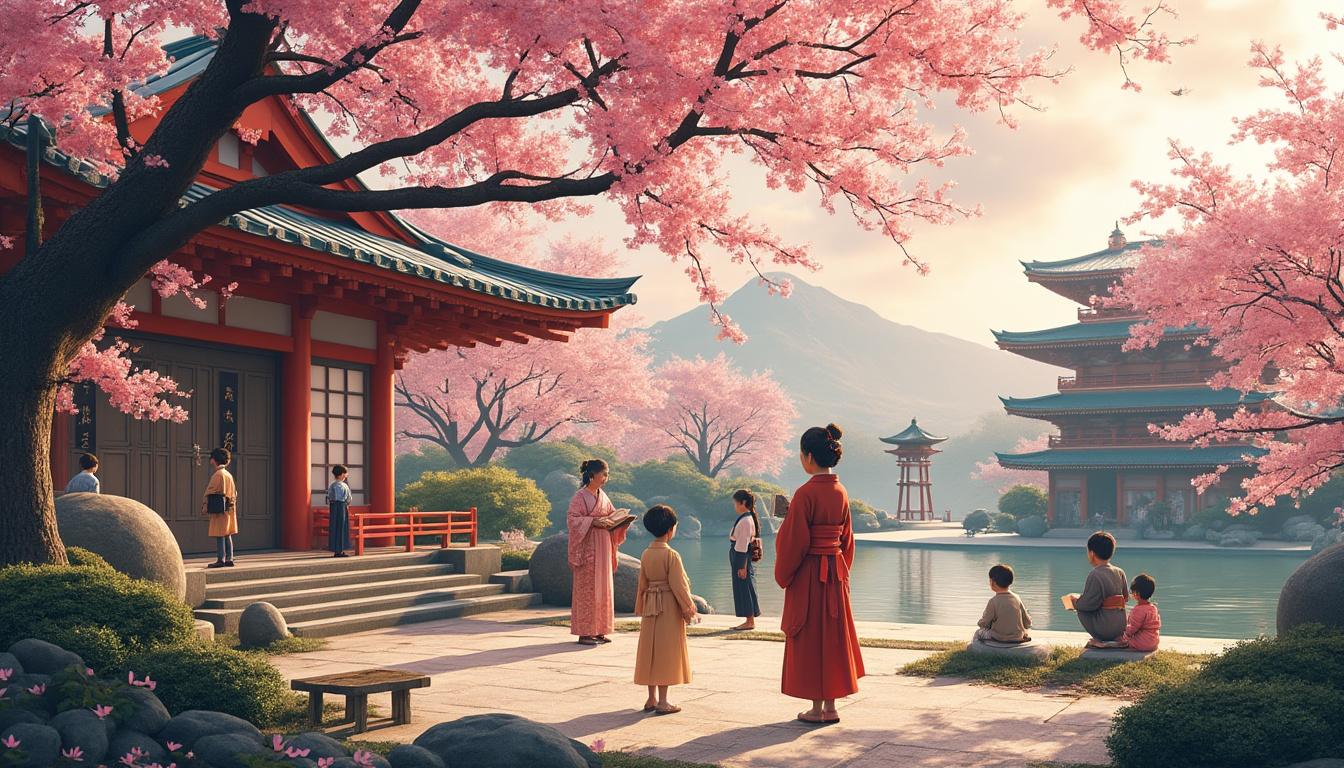
In the delicate setting of the Japanese language, first names weave a tapestry where poetry, history, and nature intertwine. Each name carries within its kanji a secret melody, a living symbol that tells more than just a simple name. From Sakura, evoking the fleeting beauty of cherry blossoms in bloom, to Akira, a burst of light and clarity, these choices reflect a deep respect for ancestral traditions while adapting to modern aspirations. It is a subtle journey between past and present, where each name embodies a wish, a quality, a strength one wishes to pass on to the child.
The article in brief
Discover how Japanese first names reveal a rich culture where each kanji tells a profound story, blending millennial tradition and modernity.
- The power of kanji: Each first name conveys a message through its graphical and sound characters.
- Tradition and innovation: The choice of names balances ancient rites and current trends.
- Astrological influence: Natural elements and onomancy often guide the name choice.
- Popular names rich in meaning: Sakura, Akira, and other symbolic names remain highly valued.
Dive into the heart of Japanese culture through its first names, far more than simple names, true narratives of history and hope.
The deep origins of Japanese first names: a cultural signature
In Japan, giving a first name is offering much more than a simple label: it is sealing a bond between the past, the family soul, and hope carried towards the future. Each first name unites the past and the present through kanji that awaken images, ideals, and natural forces. Take Haruki, for example, which combines “sun” and “tree”: a pledge of luminous energy and stability for the bearer.
This tradition is reflected in all key moments of a person’s life, where a first name acts as a talisman, imbued with strong symbolism and sincere intention. From the cradle to marriage, from rites of passage to adulthood, the name carried is much more than a name: it is a vector of identity within a society that firmly blends heritage and modernity.
Kanji: the visual and sound poetry of Japanese first names
At the heart of the Japanese mystery, kanji are these complex characters, both graphic signs and symbols full of meaning. Each kanji is read, deciphered, but above all felt. The first name Aiko, for example, unites the kanji love (愛) and child (子), creating a vibrant sweetness, while offering a rich visual identity charged with emotions.
The richness of the kanji system also lies in its flexibility: a name like Takashi can reflect either “excellence” or “eminence,” depending on the choice of characters. This freedom gives first names an infinite palette, transforming every call into a unique poetry, a sign of heritage and parental wish.
The legal framework around kanji in 2026
To guarantee clarity and coherence in Japanese society, the law strictly regulates the kanji that can be used in first names. The JIS standard, updated in 2026, authorizes a specific list of characters deemed sufficiently legible and avoids those fallen into disuse or too complex. This framework ensures administrative uniformity while preserving the beauty and symbolism of first names. Thus, every name, even the most original, must navigate discreetly between poetic freedom and firmly established rules.
The most popular Japanese first names and their poetic meanings
| Name | Kanji | Symbolic Meaning | Cultural Context |
|---|---|---|---|
| Sakura | 桜 | Cherry blossom | Symbolizes ephemeral beauty and the rebirth of spring |
| Akira | 明 / 晃 | Light, shining glare | Evokes purity, intellectual clarity |
| Hiroshi | 寛 | Generosity, tolerance | Reflects human and social values |
| Yuki | 雪 | Snow, happiness | Inspires purity and serenity |
| Takeshi | 武 | Bravery, warrior | Symbol of strength and courage |
These names, at the heart of Japanese culture, each convey a universe of meanings, values cherished by families and wished to be passed on.
Choosing a Japanese first name: between cosmic tradition and contemporary influences
In Japanese tradition, the choice of a first name often goes beyond mere aesthetics. It is common for parents to turn to onomancers, specialists in a form of astrology called onomancy, who harmonize the name, date, and natural elements such as fire, water, or earth. One thus senses the invisible dialogue with the universe, where each first name carries a destiny linked to the child’s deep nature.
But this naming ceremony does not close the door to modern trends, inspired by pop culture: manga, anime, or international influences. The name Ren, for example, has gained popularity due to its simplicity and symbolic elegance around the lotus, a sign of purity and rebirth.
Key rules for selecting a Japanese first name in 2026
- Choose simple and harmonious kanji to facilitate reading and comply with the official standard.
- Favor positive meanings, related to joy, serenity, courage, or love.
- Opt for a fluid sound, easy to pronounce both in Japan and internationally.
- Consult an onomancer to ensure a good astrological balance between first name and birth date.
- Avoid fleeting trends so that the name retains its timeless beauty.
Quiz: Origins and meanings of Japanese first names
A rich diversity: female, male, and unisex first names
| Gender | Name | Meaning |
|---|---|---|
| Female | Hana (花) | Flower |
| Female | Yuki (雪) | Snow, happiness |
| Male | Haruto (陽翔) | Light and flight |
| Male | Ren (蓮) | Lotus, purity |
| Unisex | Akira (明 / 晶) | Light, clarity |
This palette of names wonderfully illustrates the alliance between nature, character, and philosophy within Japanese culture, where each name unfolds its own musicality, a landscape of emotions and hopes.
The essential place of Japanese first names in social life
In Japan, the first name is not limited to individuality; it fits within a highly codified social relationship. Contrary to Western habits, it generally comes after the family name, like a mark of belonging that takes precedence over personal identity. Thus, Takahashi Haruto reminds that the family is often the primary foundation.
Changing one’s first name is a rare step, sometimes motivated by a deep need for personal or social renewal. The first name then becomes a subtle bridge between private identity and collective life, a reflection of the harmony sought in human relations.
Why are kanji essential in Japanese first names?
Kanji give the first name a dual function: precise pronunciation and deep meaning, offering a rich and symbolic identity.
How does Japanese legislation influence the choice of first names?
The law regulates authorized kanji to ensure legibility and social coherence, thus limiting certain rare or complex characters.
What are the most common unisex Japanese first names?
Names like Akira, Ren, or Hikaru adapt equally well to girls and boys, thanks to universal kanji and pronunciations.
Can a first name change during a lifetime?
Very rare but symbolic, a name change often aims at significant personal or social renewal.
What is the role of the first name in Japanese society?
The first name often follows the family name, emphasizing the importance of family belonging and social hierarchy.


