

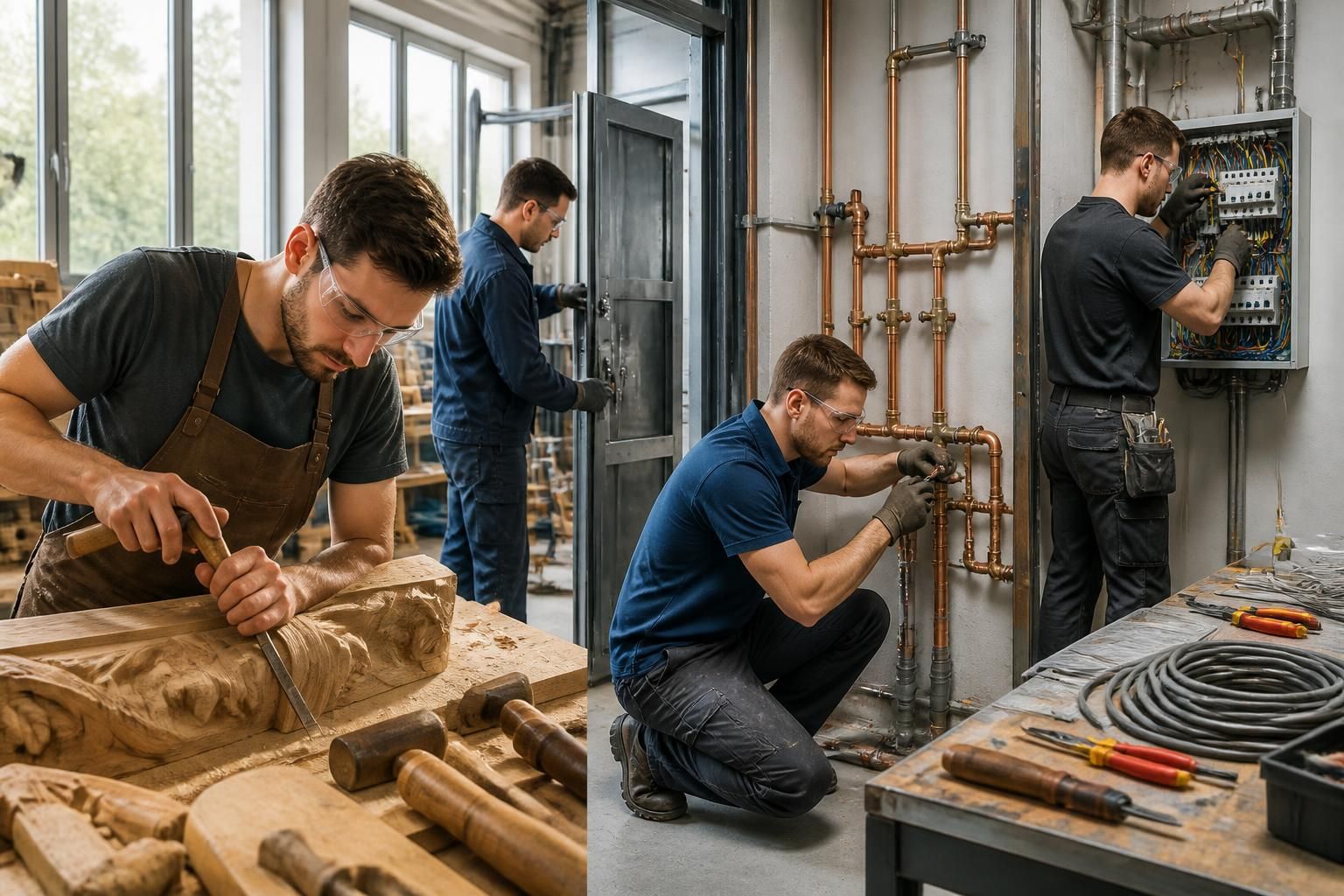
Manual trades continue to attract with a promise that goes well beyond a simple job: a way of life, concrete know-how, and tangible achievement every day. In 2026, while France faces more than 2.2 million recruitment projects, nearly half remain difficult to fill, highlighting both the scarcity and the precious value of these skills. Whether dreaming of building, creating, or repairing, these trades often offer attractive pay and promising prospects for a rewarding technical career. Whether it involves building houses, caring for green spaces, or crafting furniture, there is something for every taste and qualification level.
The article in brief
Discover how well-paid manual trades can become your pathway to a fulfilling and concrete professional future.
- Promising careers in 2026: Technical trades in high demand in construction and industry
- Suitable training: CAP, vocational baccalaureate, BP, BTS, options for quick career change
- Varied profiles: From creative to industrial, trades for every taste and physical condition
- Valued know-how: Craftsmanship and artisanal trades, combining passion and remuneration
A realistic selection to start or change careers by focusing on concreteness, autonomy, and stability.
Well-paid manual trades in 2026: a solid choice for the professional future
In times when job searching can feel like an obstacle course, manual trades offer reassuring light. More than a job, it is the possibility to touch the fruits of one’s labor, day after day. Whether it involves building a wall or caring for a green space, this technical career does not just offer an interesting salary: it also promises autonomy and rewarding know-how, in a society where “handmade” is regaining its prestige. This is especially true because the French market, according to the France Travail survey, shows over 2.2 million recruitment projects, a good part of which focus on manual and craft trades, often under tension.
What do we really mean by manual trades?
These professions rely on skillful use of hands and specific tools to create, repair, or transform. But beware, this is not a sector reserved for low-skilled profiles or simple tasks. On the contrary. An electrician or welder must show great precision and constantly update their skills in the face of evolving standards, technological innovations, and the increasing digitization of tools. Moreover, many of those with several years of experience become entrepreneurs, further valuing their passion for well-done work.
25 manual trades to discover: a varied and rich overview
From construction to craftsmanship, through mechanics, cooking, or the environment, here is a list that notably gives voice to highly sought-after qualifications this year.
- Building and construction: Mason, electrician, plumber, roofer, carpenter, building painter, tiler, glazier.
- Craftsmanship and creation: Carpenter, cabinetmaker, stonecutter, ironworker, metalworker, florist.
- Industry and maintenance: Welder, boilermaker, maintenance technician, lathe-miller, automotive mechanic, construction machinery mechanic.
- Food, aesthetics, life: Baker, pastry chef, butcher, cook, hairdresser, market gardener, landscaper.
Manual trades that recruit: focus on booming sectors in 2026
Although numerous, not all manual trades are alike nor benefit from the same opportunities. The construction sector holds a major place. France Travail figures clearly illustrate this: more than 14,700 masons, 11,000 electricians, and 11,000 heating plumbers are expected this year. This recruitment tension reflects strong demand combined with sometimes insufficient supply. Alongside, the industry continues to call upon technical profiles, notably boilermakers, welders, and mechanics, who also face recruitment difficulties. Not to forget the catering and food trades sector, always essential for local life and offering often attractive wages, especially with experience.
Comparative table of manual trades: strengths, training, and choice criteria
| Manual trade | Sector | Common training | Strengths | To check before choosing |
|---|---|---|---|---|
| Electrician | Construction, energy, maintenance | CAP, vocational baccalaureate, professional title | Technical trade, booming market | Compliance with standards, frequent travel |
| Plumber | Construction, repair, renovation | CAP, vocational baccalaureate, apprenticeship | Autonomy, strong daily usefulness | Emergencies, physical work |
| Carpenter | Craftsmanship, fitting out | CAP, vocational baccalaureate, BP | Creativity, precision | Dust, heavy loads |
| Welder | Industry, metallurgy | Professional title, CAP, certifications | High demand, possible specialization | Precision, demanding technical gestures |
| Maintenance technician | Energy, industry | Vocational baccalaureate, BTS, professional title | Versatility, diagnostics | Shift work, constant vigilance |
| Pastry chef | Cooking, food craftsmanship | CAP, complementary mention, vocational baccalaureate | Creative, visible production | Early hours, intense pace |
| Landscaper | Green spaces, environment | Agricultural CAP, vocational baccalaureate, BTS | Outdoor work, project variety | Weather, physical effort |
Training for manual trades: paths adapted to everyone
The classic path often begins with a CAP accessible after 9th grade, in two years, to acquire a solid foundation. The vocational baccalaureate, in three years, broadens skills, while the Professional Certificate (BP) is for those wishing to gain expertise. Increasingly, work-study training provides a rich balance between theory and practice. For adults changing careers, professional titles and targeted training allow quick entry into a new activity, sometimes with recognition of prior learning (VAE) to valorize past experience. The essential thing remains to choose training well according to one’s goals, constraints, and desires, with particular attention given to reputable organizations and immersion internships.
Career change into manual trades: how to approach this change?
Leaving an abstract career for something tangible is the motivation of many adults seeking meaning. A successful career change requires introspection: do we really like to work with our hands? Are we physically ready? Is there real local demand? It is often in the construction or craft sectors that this transition works best, but not only there. Immersion in the trade, exchange with professionals, and preparation for training are essential steps. Valuing previous skills through VAE can also open doors faster.
Choosing the right manual trade: questions to ask yourself
Each manual trade has its specifics. To thrive, one must consider their relationship to physical work (carrying loads, standing), their attention to detail or diagnosis ability, desire for client contact, and long-term career prospects. Working in a workshop, outdoors, in a shop, or on a construction site does not offer the same experience. In this diversity, the first step remains to observe what truly attracts you, then to move forward with curiosity and method. This choice can, with some patience, open up a meaningful, stable, and well-paid career.
A list of essential criteria for making the right choice
- Physical conditions: Resistance to carrying loads, working standing up or outdoors.
- Required quality: Precision, technicality, rigor in compliance with standards.
- Customer relations: Are you comfortable with direct contact or do you prefer work behind the scenes?
- Autonomy vs. team: Do you wish to work alone or in collaboration?
- Perspectives: Do you want to move towards management, entrepreneurship, or remain a specialist?
Which manual trades are recruiting the most this year?
Building trades such as mason, plumber, electrician, as well as those in industry like welder and boilermaker, are in high demand according to 2026 data from France Travail.
How to train quickly for a manual trade?
Professional training such as CAP or vocational baccalaureate, often work-study, is accessible from 9th grade and allows acquiring the necessary skills in 2 to 3 years. Adults can also benefit from professional titles or VAE.
Are manual trades suitable for career change?
Yes, many manual trades accept adults changing careers with targeted training. It is essential to evaluate one’s motivations, physical condition, and local opportunities before committing.
Can you earn a good living in manual trades?
Salaries can be very attractive, especially with experience, in technical trades, independent activities, or specialized fields like electrician, plumber, or welder.
Do you need a long diploma to practice a manual trade?
Many manual trades are learned from the CAP, accessible after 9th grade, without a long diploma. Additional training exists to gain skills, but the duration remains reasonable.


