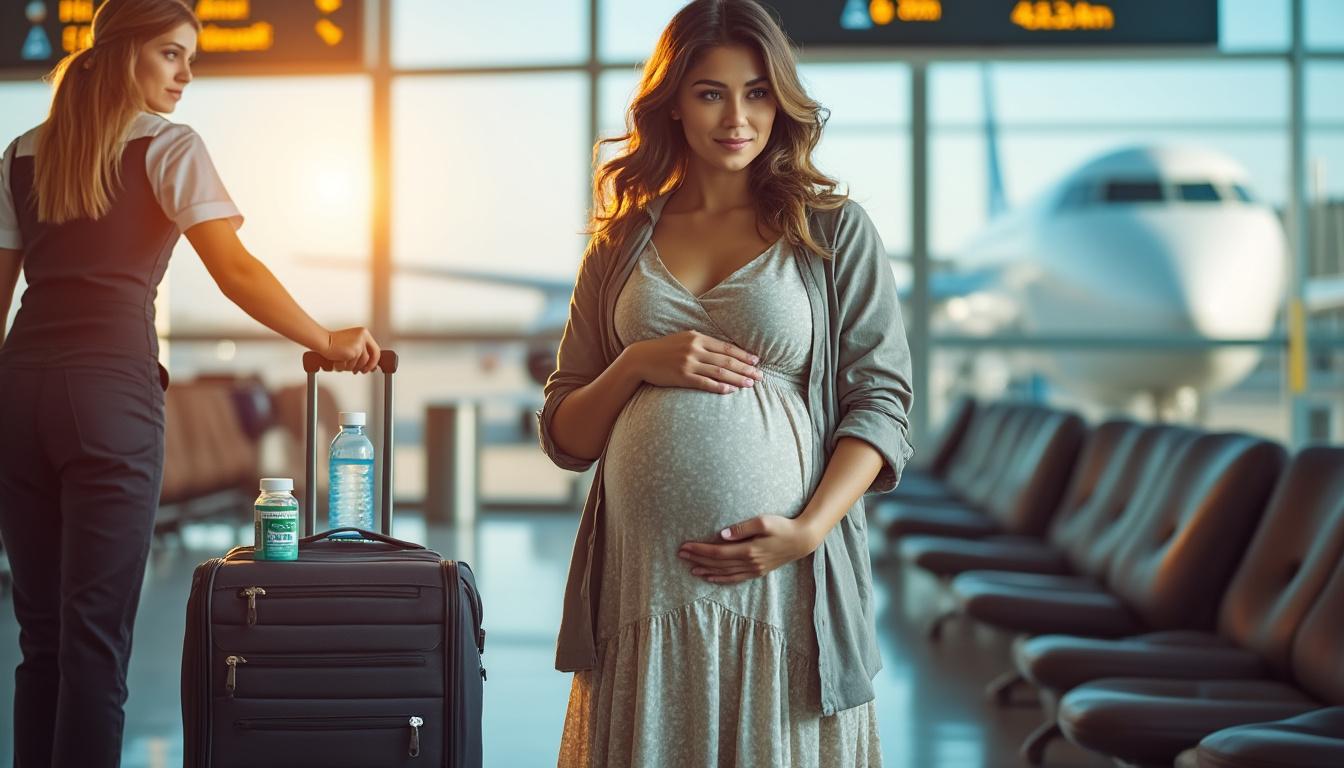
Flying during pregnancy, a topic that combines excitement and caution, deserves careful consideration. While the prospect of flying while pregnant may seem delicate, it is often well managed provided one is familiar with the recommended periods, possible airline restrictions, and precautions to take. Between managing symptoms, adopting the right pace, and choosing the airline, every expectant mother can approach this journey calmly. Focus on enlightened advice for flying pregnant without unpleasant surprises.
Article in brief
Flying pregnant is possible but requires a good understanding of personal needs, airline policies, and applying best practices to avoid stress and discomfort.
- Ideal travel periods: Prefer the second trimester for maximum comfort during the flight.
- Certificate and rules to follow: Mandatory after 28 weeks, conditioned according to the airline.
- Essential precautions: Hydration, regular movements, compression stockings to avoid phlebitis.
- Risks to know: Venous thrombosis and premature birth, managed by good preparation.
Well-prepared, the airplane journey transforms from a stressful moment into a controlled and serene experience both for mother and baby.
Flying pregnant: understanding recommendations by trimester
At every stage of pregnancy, the body changes, and air travel imposes its own constraints. From the first trimester (0–13 weeks of amenorrhea), there are no strict medical contraindications: the pressurized cabin is well tolerated. However, fatigue and morning sickness can turn a few hours into a real challenge. Moreover, fear of miscarriage – more frequent at this stage but not related to flying – leads some to postpone their trip.
The second trimester (14–27 weeks) is seen as the golden window for travel: nausea has generally disappeared, and energy returns. The belly gradually rounds without yet hindering sitting or movement. This is also the period when the risk of complications significantly decreases. Alongside regained comfort, it is still advised to limit the flight duration to 4 or 5 hours out of caution, especially for long neurasthenic flights.
In the third trimester (28 weeks and beyond), rules tighten: airlines often impose restrictions, with varying limits between 32 and 36 weeks depending on whether it is a singleton or multiple pregnancy. The medical certificate of non-contraindication is almost always required, an essential step before booking. Attention focuses especially on preventing edema, phlebitis, and the potential risk (although rare) of premature delivery during the flight.
Main rules by trimester
| Trimester | Weeks of amenorrhea | Medical certificate | Key points |
|---|---|---|---|
| 1st trimester | 0–13 | Not mandatory | Travel possible, frequent nausea and fatigue |
| 2nd trimester | 14–27 | Not mandatory | Most comfortable and recommended period |
| 3rd trimester | 28–36 | Mandatory after 28 weeks | Stricter restrictions, increased risks |
Airline restrictions and impacts on flight preparation
With pregnancy, flying requires clarity on protective rules that vary by airline. The absence of specific national regulation means each carrier sets its own thresholds. Air France remains relatively flexible, advising against flying beyond 36 weeks for a singleton pregnancy but not making the medical certificate systematic before that time. EasyJet generally limits travel to 35 weeks, requiring a certificate from 28 weeks.
This disparity demands increased vigilance before booking: reading the conditions on the airline’s official website avoids many inconveniences at boarding. The medical certificate of non-contraindication, issued by a doctor, is recommended as a precaution in all cases from the third trimester onward. Also, informing staff about the pregnancy often allows for priority boarding and attentive support throughout the flight.
Overview of key policies of major European airlines
| Airline | Simple pregnancy limit | Multiple pregnancy limit | Medical certificate |
|---|---|---|---|
| Air France | 36 weeks (discouraged beyond) | 32 weeks | Recommended, not mandatory |
| EasyJet | 35 weeks | 32 weeks | Mandatory after 28 weeks |
| Ryanair | 36 weeks | 32 weeks | Mandatory after 28 weeks |
| Lufthansa | 36 weeks | 32 weeks | Certificate to be signed by doctor |
Practical advice for a comfortable and safe journey
Several actions greatly facilitate the experience of flying pregnant. Comfort begins with clothing choices: opt for loose outfits, maternity leggings, and shoes that are easy to remove, without compression on the belly or legs. To effectively combat phlebitis, the winning trio consists of wearing class 2 compression stockings, regular hydration, and movements every hour (such as walking in the aisle or ankle rotations while seated).
Dry air in the cabin (about 20% humidity) dries the skin and can encourage dehydration: carrying a reusable water bottle filled after security checks is essential to maintain constant hydration. An alcohol-free thermal water spray to mist the face helps soothe the feeling of tightness. Regarding food, favor healthy, light, and frequent snacks (dried fruits, almonds, crackers) to avoid digestive discomfort and nausea.
Finally, for back comfort, a lumbar cushion or a rolled-up blanket at the lower back makes a big difference. Inform staff at boarding about your pregnancy: cabin crew are often very attentive and willingly offer assistance and adapted support. The concern for maximum comfort and vigilant care is logical when you know this experience involves a double traveler, the baby-to-be.
- Prefer an aisle seat to facilitate frequent movements
- Wear clothing that does not squeeze belly or legs
- Drink at least 250 ml of water per hour of flight
- Get up and walk at least once per hour
- Use a lumbar cushion to reduce back pain
- Position the seatbelt under the belly, at hip height
- Inform staff of your pregnancy for priority assistance
Risks related to flying during pregnancy and how to manage them
The risk of venous thrombosis represents the main medical concern. Pregnancy naturally increases this risk, and prolonged immobility during the flight can worsen the situation. The efficiency of wearing compression stockings is well proven, reducing the risk of asymptomatic thrombosis by 90% according to recent studies. On flights longer than 4 hours, this protection is even more important, as is prior consultation to consider medicinal prevention if necessary.
Premature birth in flight is feared but statistically rare, which is why airlines set strict limits in terms of weeks of amenorrhea. Cabin pressure, equivalent to an altitude between 1800 and 2400 meters, is generally well tolerated by mother and baby thanks to fetal hemoglobin, which is more effective in binding oxygen.
Finally, the unfounded belief that flying causes miscarriage must be put aside: first trimester miscarriages are related to chromosomal issues independent of flying. It is better to focus on what matters: taking precautions, providing good information, and good organization so that everything goes as smoothly as possible.
Practical information to prepare your departure calmly
Before leaving, do not forget the essential medical consultation, even if the pregnancy appears uncomplicated. This moment also serves to prepare the first aid kit with appropriate medications and to check vaccinations depending on the destination. Taking out insurance adapted to your condition is another must: ensure it covers pregnancy-related risks and medical repatriation, often necessary in emergencies abroad.
Allow plenty of time at the airport: three hours before boarding for international flights to avoid stress, especially with security lines that require standing. No concern passing through security gates: they are safe, with no ionizing radiation emitted by these devices.
The good reflex is to inform the crew at boarding: this way, you benefit from special attention and immediate support in case of discomfort. Having your medical file at hand is a plus that reassures as much as preventive discussions with staff.
Essentials to bring for a successful flight while pregnant
- Medical certificate of non-contraindication, especially after 28 weeks
- Class 2 compression stockings to prevent phlebitis
- Reusable water bottle and facial moisturizing spray
- Light and practical snacks such as dried fruits or almonds
- Comfortable clothing adapted to pregnancy
- Essential medical documents and emergency contacts
- First aid kit with usual and specific travel medications
Frequently asked questions about pregnancy and air travel
Up to how many weeks can you fly while pregnant?
It is generally possible to travel up to 36 weeks for a singleton pregnancy and about 32 weeks for a multiple pregnancy, respecting airline regulations. The medical certificate often becomes mandatory after 28 weeks.
Do you need a medical certificate to fly while pregnant?
Before 28 weeks, most airlines do not require it. Beyond this, it is almost always requested to certify fitness to fly. This document is easy to obtain from your general practitioner or gynecologist.
Can you fly when seven months pregnant?
Yes, but it depends on the airline. Most accept up to 36 weeks for a singleton pregnancy with a medical certificate. Strictly following recommended precautions such as wearing compression stockings and regular hydration is necessary.
Can flying cause a miscarriage?
No. First trimester miscarriages are related to chromosomal abnormalities or causes independent of flying. There is no proven link between flying and miscarriage.
Is it risky to pass through security gates while pregnant?
There is no known risk in passing through security gates or millimeter wave scanners at airports during pregnancy. They do not emit ionizing radiation that could affect the fetus.