

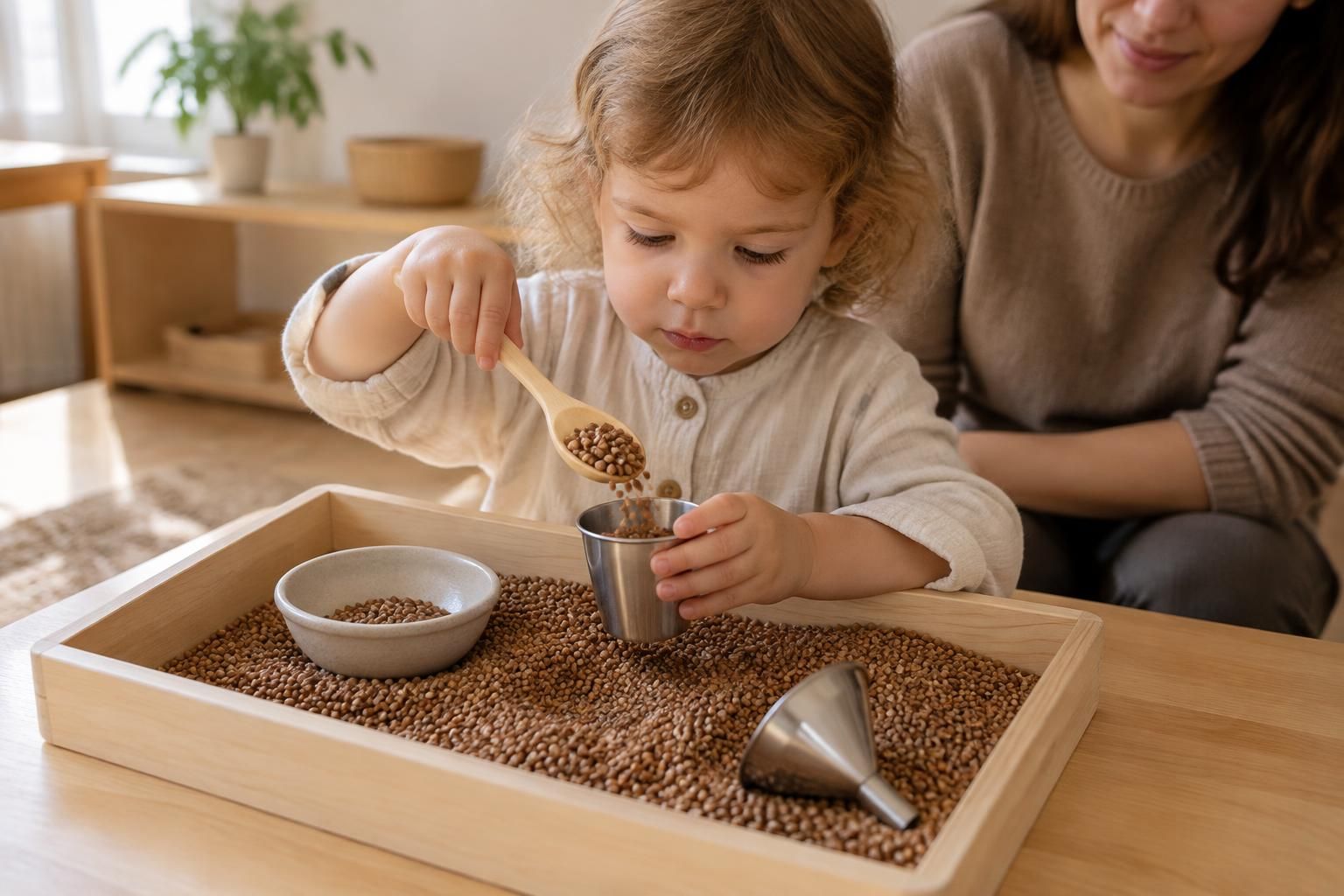
A tray, some buckwheat grains, and everyday utensils: it takes little to turn a quiet moment into a real exploration ground. This Montessori activity invites the child to touch, listen, fill, and empty, all while developing fine motor skills. With a few simple precautions and a well-prepared space, the sensory bin becomes a playful, accessible, and discovery-rich activity for children.
The article in brief
Buckwheat grains make up an easy-to-prepare sensory bin, conducive to tactile exploration and precise small movements. Here’s how to safely offer this activity and adapt it to the child’s age.
- Preparation without hassle: A stable tray, clean grains, and a few containers are enough.
- Movements that promote growth: Filling, pouring, and transferring develop coordination and fine motor skills.
- Safety first: Close supervision is essential, especially with young children.
- Easy-to-imagine variations: Spoons, cups, and small objects refresh the activity without overloading the bin.
This educational activity turns a simple material into an invitation to observe, manipulate, and learn at one’s own pace.
Why offer a sensory bin with buckwheat grains
Dry grains offer a unique sensation: they slip between fingers, rustle in a bowl, and change volume when moved. This tactile exploration fuels sensory awakening, but also curiosity: what happens if we pour gently, or fill a container to the brim?
In the Montessori spirit, the child discovers by handling and repeats as much as they wish. Transferring seems quite simple, yet it requires coordination between eye and hand, concentration, and fine motor skills. The pleasure often comes from these repeated gestures, much more than from a result to show.
A Montessori activity that follows the child’s pace
A child may first observe the grains, then touch them with fingertips before grasping a spoon. It’s not necessary to show them immediately what to do: leaving the materials accessible and calmly presenting the gestures is often enough to start exploration.
This activity for children does not need a complicated goal. A small challenge, like filling a cup or moving grains from one bowl to another, may appear naturally during play.
How to prepare a buckwheat sensory bin safely
Choose a stable tray, wide enough to contain the grains, and place it on an easy-to-clean surface. Pour a small amount of buckwheat into the bin, then add two or three accessories: a spoon, a small jar, and a cup are enough to start.
The grains are not meant to be eaten. As they present a choking hazard, this setup is only suitable for a child able to follow instructions and must take place under the constant supervision of an adult. For toddlers who still put objects in their mouths, it is better to choose a sensory activity without small elements.
Useful materials for a first session
Before starting, check that the buckwheat is clean and dry, that containers are neither sharp nor fragile, and that the space is clear. If the child has a known allergy to buckwheat or a particular food sensitivity, do not offer this material without appropriate advice.
- A tray or bin with edges, placed flat.
- A small amount of buckwheat grains poured into the bin.
- Unbreakable bowls or cups, in different sizes.
- A spoon suitable for the child’s hands.
- A mat or sheet under the tray to facilitate tidying up.
A simple setup helps the child focus on one action at a time. The mat, meanwhile, prevents a few wandering grains from ending up under the sofa.
Ideas for transferring to develop fine motor skills
When the bin is ready, first let the child explore freely. They can slide the grains in their hand, listen to them fall, or fill a container at their own pace. Repetition is not a lack of imagination: it allows better control of the gesture and observation of its effects.
To evolve the Montessori activity, offer only one new accessory at a time. A smaller spoon requires more precision, while two containers of different sizes allow comparison of their capacity, without turning the play into a forced exercise.
| Suggestion | Movement explored | What the child discovers |
|---|---|---|
| Fill a cup with a spoon | Pick up and deposit | Precision and eye-hand coordination |
| Pour from one bowl to another | Tilt and measure | The movement and sound of the grains |
| Compare two containers | Fill then empty | Differences in volume and shape |
| Gather grains with a scoop | Push and guide | Gesture control and orientation |
Adapting the educational activity to age and attention
The duration depends on the child: a few minutes can already be a good exploration time. An older child may enjoy filling containers according to simple instructions, while a beginner will willingly just pour and repeat.
To keep the experience pleasant, it is better to stop when attention drifts or when the grains go more on adventures than in transferring. Shared tidying up can also be part of learning through play: the adult shows how to gather the grains, then the child participates according to their abilities.
Frequently asked questions about the buckwheat sensory bin
At what age should buckwheat grains be offered?
This activity is intended for children who no longer put small objects in their mouths and can follow safety instructions. The grains present a choking hazard: constant adult supervision remains essential.
How long does a sensory bin session last?
There is no imposed duration. A few minutes are sufficient if the child is focused; the session can continue as long as they handle calmly and remain under supervision.
How to clean up after the activity?
Gather the grains on the mat or in the tray, then store them in a closed, clean container if the material remained dry and was not put in the mouth. Then clean the playing surface.
What to do if the child still puts objects in their mouth?
Avoid grains and any other small elements. Prefer a sensory activity adapted to their age, with large materials and always used under adult supervision.


